









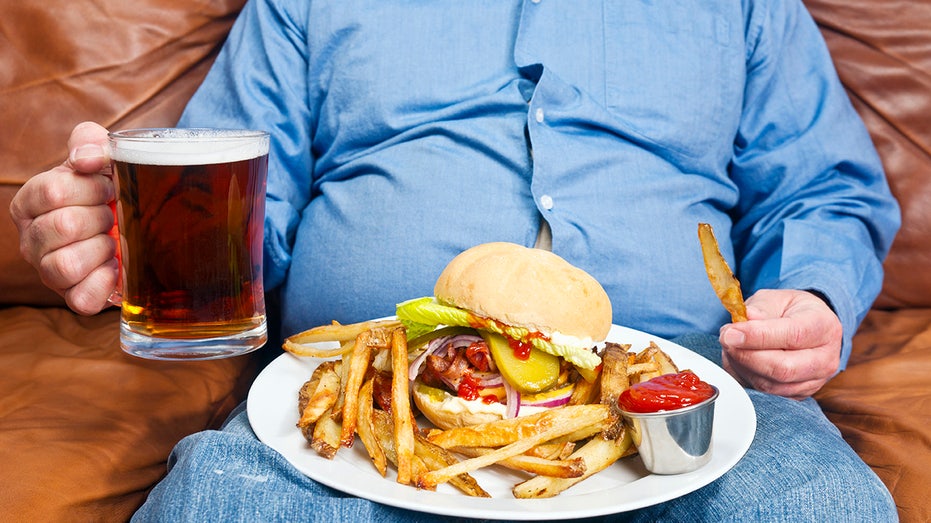
From fast-food to ultra-processed snacks, a high-fat diet eaten over the long term may trigger biological changes in the liver that could raise the risk of cancer.
Researchers from the Massachusetts Institute of Technology (MIT) suggested it may be less about how much fatty food is consumed at once — and more about how long the liver is exposed to a high-fat diet.
Over time, a high-fat diet may put liver cells into a kind of survival mode that researchers believe could make them more vulnerable to cancer-related changes, according to the research published in December in the journal Cell.
HIGH-FAT DIET MAY TRIGGER CHEMICAL CHAOS IN THE GUT AND BRAIN, RESEARCHERS FIND
The scientists found that when the liver repeatedly processes large amounts of fat, its main working cells stop focusing on breaking down nutrients and filtering toxins. Instead, they revert to a more primitive state to help them endure the strain of a fatty diet, a shift researchers associate with tumorigenesis, the process by which cancer can develop.
"If cells are forced to deal with a stressor, such as a high-fat diet, over and over again, they will do things that will help them survive, but at the risk of increased susceptibility to tumorigenesis," Alex K. Shalek, one of the study's senior authors and director of MIT's Institute for Medical Engineering and Sciences, said in a statement.
The study focused on mice fed a long-term high-fat diet, some of which went on to develop liver cancer.
By examining liver cells as the disease progressed, researchers saw that healthy liver functions slowly shut down and survival traits took over. When they examined human liver samples, researchers observed comparable declines in normal liver activity, though without tracking long-term cancer outcomes.
‘MEATEATER’ HOST SAYS WILD GAME IS ‘THE HEALTHIEST FOOD’ AMERICANS CAN EAT
"This really looks like a trade-off, prioritizing what's good for the individual cell to stay alive in a stressful environment, at the expense of what the collective tissue should be doing," co-first author and MIT graduate student Constantine Tzouanas said in a statement.
"These cells have already turned on the same genes that they're going to need to become cancerous," he added. "Once a cell picks up the wrong mutation, then it's really off to the races, and they've already gotten a head start on some of those hallmarks of cancer."
The findings help explain why fatty liver disease often precedes liver cancer — and why the effects of diet may take years or even decades to show up.
Researchers found that patients whose liver cells showed more stress-survival changes and less normal liver function tended to live for a shorter time after cancer developed. While this process unfolds within about a year in mice, scientists estimate it could take decades to occur in humans.
The researchers stressed that the findings relate to long-term eating patterns rather than occasional indulgent meals.
While the study did not focus on specific foods, experts generally recommend moderation and balanced eating patterns.
Because the research was conducted primarily on animals, the findings should be interpreted cautiously when applied to humans, said Dr. Ghassan Abou-Alfa, an oncologist specializing in gastrointestinal cancers at Memorial Sloan Kettering Cancer Center in New York City. He was not involved in the new research.
Even so, the results offer new insight into the biological processes that may help explain how fatty liver disease can progress to liver cancer, a condition that can also affect people who are not morbidly obese.
"This can be any of us, and we need to adapt our lifestyles to avoid turning healthy liver cells into cancer cells," said Abou-Alfa.
CLICK HERE FOR MORE LIFESTYLE STORIES
He also noted that healthy fats are a necessary part of our diets.
"There is no sure way to prevent cancer, but there are changes you can make to potentially lower your risk," Karen Smith, an oncology dietitian at Texas Oncology, told Fox News Digital.
"Your overall lifestyle matters more than any single food," added Smith, who was also not involved in the new research. "Maintaining a healthy weight, not smoking, and staying active can all make a difference."
CLICK HERE TO SIGN UP FOR OUR LIFESTYLE NEWSLETTER
She also recommended limiting red and processed meat, choosing proteins such as fish, chicken, beans and lentils, and eating a balanced diet rich in fruits, vegetables, whole grains and legumes.
The MIT researchers cautioned that the findings are based largely on mouse models and early genetic changes, do not fully explain how disrupted fat metabolism leads to cancer, and do not account for factors such as insulin resistance, inflammation or alcohol use.
The team now plans to study whether shifting to healthier eating patterns or using GLP-1 weight loss medications could help restore normal liver cell behavior and lower future cancer risk.
TEST YOURSELF WITH OUR LATEST LIFESTYLE QUIZ
Previous research has also suggested that long-term high-fat diets can disrupt how the gut and brain communicate, affecting appetite, mood and metabolism, Fox News Digital previously reported.
Fox News Digital reached out to the study's authors for comment.
The post Your liver may already be changing because of what you eat every day, scientists warn appeared first on FOX News