













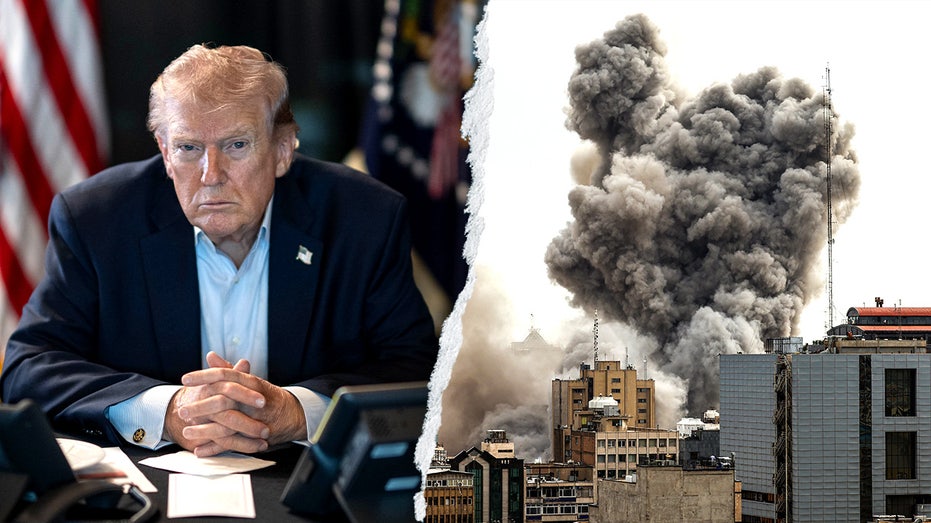





















President Donald Trump’s legal case for ordering strikes on Iran without prior congressional authorization is not novel, according to legal scholars, and instead tracks the modern Article II template that past presidential administrations have used to justify limited military operations abroad.
"Whether you agree or disagree with Obama or any of the other presidents who used military force, like in Haiti with 20,000 troops on the ground (in 1994 under the Clinton administration), this is what the founders anticipated when they divided the power," Heritage Foundation senior legal fellow and acting director of the Institute for Constitutional Government Cully Stimson told Fox News Digital in a phone interview Monday.
"They did not want to have what we had in Mother England, where the king made the decision alone," he said.
Trump’s Iran strikes are reigniting the long-running tug-of-war between Congress’ war powers and presidents’ Article II claims to act quickly against threats. Legal scholars and critics point to past precedents and the War Powers Resolution as the key guideposts as some lawmakers move to curb further action in Iran.
The U.S. military launched joint strikes with Israel on Iran beginning Saturday without congressional approval. Trump administration officials said they provided congressional notification to the "Gang of Eight," a bipartisan group of top congressional intelligence leaders, ahead of the strikes, but Congress did not hold a vote to approve them.
Instead, the Trump administration has argued that the U.S. was facing an "imminent threat." Secretary of State Marco Rubio said the U.S. was not going to "sit there and absorb a blow" from Iran and that the operation was needed at this juncture, while Defense Secretary Pete Hegseth said the operation "is not a so-called regime change war" or a war like in Iraq that was open-ended, but a targeted mission born out of escalating threats.
"Our president has guts," Hegseth said during a press conference Monday. "Iran's stubborn and self-evident nuclear pursuits, their targeting of global shipping lanes and their swelling arsenal of ballistic missiles and killer drones were no longer tolerable risks. Iran was building powerful missiles and drones to create a conventional shield for their nuclear blackmail ambitions."
Democratic lawmakers, as well as some Republicans, have denounced the strikes as "illegal," arguing they did not obtain congressional approval first and drafting resolutions that would require Trump to seek congressional approval to use military force in Iran.
"This is an illegal war," Democratic Virginia Sen. Tim Kaine said during an appearance on "Fox News Sunday." "I have a war powers resolution queued up for vote this week, and I’m encouraging my colleagues to assert the constitutional power vested in the legislative branch."
Kaine, who has been one of the more vocal Democrat lawmakers denouncing the strikes, argued they are "illegal" because "the Constitution can’t be changed by statute. The Constitution says no declaration of war without Congress."
Under the Constitution, Congress holds the power to declare war and control war funding, while the president, as commander in chief under Article II, directs military operations and can act to protect U.S. forces and interests in time-sensitive situations.
'THE RIGHT THING': PAXTON, CORNYN TRADE BLOWS IN TEXAS PRIMARY BUT UNITE FOR TRUMP'S IRAN STRIKES
The 1973 War Powers Resolution was Congress’ attempt to police that split in power. It requires the president to notify Congress within 48 hours of introducing U.S. forces into hostilities or imminent hostilities, and it sets a 60-day clock to end the operation absent a declaration of war or specific authorization.
"This is sort of the built-in tension between the legislative branch — which is under Article One, Section Eight, Clause 11 and has the declare-war power — and the commander in chief, who cannot prosecute a war without money appropriated and paid for by Congress," Stimson explained.
A White House official told Fox News Digital on Tuesday that "the President exercised his authority as Commander in Chief to defend U.S. personnel and bases in the region against an implacable enemy."
The official continued that Iran "has spent the last four decades attacking Americans to pursue its radical agenda and the last four weeks manipulating the diplomatic process to buy time to build up its offensive military capabilities increasing the regime’s threat to U.S. personnel, our bases, and allies in the region and around the world."
Stimson pointed to a long line of modern precedents in which presidents of either party have launched military operations without a new authorization for use of military force, arguing that the executive branch has repeatedly relied on Justice Department Office of Legal Counsel guidance to determine when a strike falls short of "war" in the constitutional sense.
"Most presidents, especially in modern times, have used the military in the national interest of the United States, and they determine what is in the national interest … without congressional authorization," Stimson said.
Stimson said the key legal argument administrations have used — including in a 2011 OLC opinion on Libya under the Obama administration — turns on whether an operation is expected to be "prolonged and substantial," typically involving U.S. personnel facing significant risk over a substantial period.
If the president "reasonably thinks or represents that there’s no anticipated prolonged military engagement" and no anticipated significant risk to U.S. personnel over time, Stimson argued, the requirement to go to Congress for a declaration of war is not triggered.
REP RO KHANNA: CONGRESS MUST RECLAIM WAR POWERS FROM AN OUT-OF-CONTROL TRUMP OVER IRAN
In practice, Stimson said, presidents typically comply with the War Powers Resolution’s initial reporting requirements by notifying Congress within 48 hours and describing the expected scope and duration of the deployment.
"Then there’s sort of a 60-day clock that people talk about," he said, referring to the statute’s termination provision, which requires the president to end the use of force within 60 days absent a declaration of war or specific authorization, with a potential 30-day extension.
Trump has said the operation is expected to last just a month or five weeks, short of the 60-day clock.
Gene Hamilton, former White House deputy counsel and president of America First Legal, told Fox News Digital that the president has "broad inherent authority under Article II of the Constitution to defend U.S. interests and safety."
"The Constitution, in Article II, Section 2, vests the President with powers as the Commander in Chief," Hamilton explained. "He is ultimately vested with operational command of the military. The Founders understood and would not have required the President of the United States to go before Congress and seek approval every time he needed to act to secure U.S. interests with military assets abroad."
The Framers at the Constitutional Convention in 1787 changed Congress’ power from "make war" to "declare war," a shift scholars say was meant to let presidents respond to sudden attacks while leaving lawmakers the authority to authorize full-scale war.
NETANYAHU INSISTS US AND ISRAEL'S STRIKES ON IRAN WON'T LEAD TO 'ENDLESS WAR'
Hamilton said the Founders worked to ensure "that the Constitution does not impose insurmountable barriers to the president's inherent ability to engage in military action to defend U.S. interests. ‘Making war’ would require the president to engage in a glorified act of cat herding every time he believes military action of any kind is necessary — an outcome so nonsensical it needs no further explanation," he said.
Hamilton said the White House has "access to intelligence that puts them in the best position to make these decisions, invoking our inherent right to self-defense."
"In the case of Iran, there is a documented, demonstrable history of the Iranian regime engaging in overt acts of hostility against U.S. interests for decades. Many innocent Americans have died as a result of direct or indirect attacks by Iran through proxy actors," Hamilton said.
"The president is on firm ground," he continued.
The post Trump’s Iran strikes get legal cover as scholars say Article II playbook spans Obama era and beyond appeared first on FOX News