






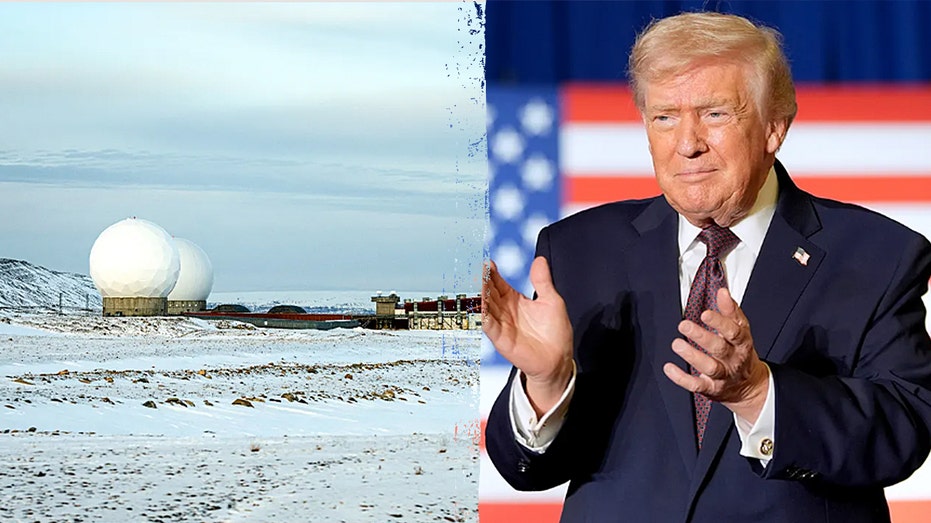













The U.S., Denmark and Greenland formally signed President Donald Trump’s new Greenland security agreement on the sidelines of the U.N. General Assembly Tuesday, cementing permanent U.S. military rights on the strategically vital Arctic island after months of negotiations over Trump’s push for greater American control.
Trump, Prime Minister Mette Frederiksen of Denmark and Prime Minister Jens-Frederick Nielsen of Greenland met Tuesday morning for a trilateral signing ceremony, where the three parties praised each other's defense cooperation over the past 75 years, through World War II and the Cold War.
In brief remarks, Trump praised both prime ministers for their efforts in making the deal happen, adding that, "we're going to have a tremendous relationship, a secure relationship, and we look forward to it, and we'll be working very hard and very much in conjunction with each other."
Frederiksen expounded upon the strategic importance of the alliance.
TRUMP DECLARES VICTORY IN HISTORIC DEAL WITH GREENLAND AS HE SECURES 'PERMANENT' US MILITARY RIGHTS
"Mr. President, ever since the Second World War, the United States has defended the free world, created prosperity and progress, peace and freedom, and I am very proud to say that in the Kingdom of Denmark, the United States has a friend that has always kept our word, an ally you have always been able to rely on, and this day represents a milestone in our long-standing cooperation," she said.
The U.S. has held extensive military rights in Greenland for decades under a 1951 defense agreement, but administration officials say the new pact goes further by allowing Washington to establish additional military installations without separate Danish or Greenlandic approval, explicitly barring adversaries from establishing a military presence and creating a mechanism to block adversarial investment in sensitive sectors.
"This deal is good for the United States, it's good for Greenland, for Denmark, for the NATO alliance, and therefore also good for Europe," Frederiksen continued. "In other words, we are strengthening our common security, boosting our common deterrence, showing our adversaries who we are, and we are doing it together."
Nielsen echoed the message.
"The world has changed a great deal since 1951," he said. "A notable change is Greenland itself at the table today, signing this agreement, and for Greenland, this is not only an agreement about us, it is a, agreement with us. It takes into account the people of Greenland, our rights, our livelihoods, and the development of our country," he said.
He explained that the agreement makes clear where Greenland stands on the world stage — staunchly in defense of the West against adversaries like Russia and China.
"The security landscape in the Arctic is changing, and we recognize the long-term security threats that you, Mr. President, have rightly spoken about," he continued. "It is for that very reason that we have insisted on engaging in a constructive dialogue. Greenland matters for North American security and for transatlantic security, and this agreement reflects that we understand our responsibility and act accordingly. And NATO matters. We believe that it's vital to keep NATO strong, also in the Arctic, where the alliance has a key role to play."
The new agreement stops short of the territorial acquisition Trump had sought for much of the year, when he repeatedly argued that U.S. ownership of Greenland was necessary for national security and pressed Denmark to relinquish control of the strategically located Arctic territory.
Those demands sparked a diplomatic standoff with Copenhagen and Nuuk, where leaders insisted Greenland was not for sale and stressed that its future could be decided only by the Greenlandic people.
DENMARK VOWS TO DEFEND GREENLAND AFTER TRUMP REITERATES US SHOULD CONTROL TERRITORY
Greenland is a self-governing territory within the Kingdom of Denmark, with Copenhagen retaining authority over foreign, defense and security policy while Greenland controls many of its domestic affairs, including mineral resources.
The new agreement instead leaves sovereignty unchanged while granting Washington expanded and permanent security rights. Frederiksen has emphasized that the pact recognizes "the sovereignty and territorial integrity of the Kingdom" as well as Greenlanders’ right to self-determination, even as Trump has characterized the agreement as giving the U.S. "permanent control" over Greenland’s security.
For Greenland, Tuesday’s signing is also intended to close a turbulent chapter that left residents of the sparsely populated island wondering how far Trump was prepared to go to bring it under U.S. control.
Greenland Foreign Minister Múte B. Egede said the agreement respects the government’s longstanding "red lines," including Greenlanders’ right to self-determination, while allowing Nuuk to deepen defense cooperation with the United States and other Western allies. But he acknowledged that Trump’s earlier threats had taken a toll.
"The last nearly two years have been challenging for the Greenlandic population," Egede told Greenlandic broadcaster KNR. "Many people have been uncertain. Uncertain about our future."
Some Greenlanders remain wary as they wait to see the full agreement. Residents interviewed over the weekend expressed concern about how a larger American military footprint could affect life on the island, while Greenlandic politicians have urged the public to reserve judgment until the final text is signed and released.
Frederiksen, meanwhile, sought Monday to draw a firm line between expanded U.S. military access and American sovereignty over the territory.
"We are not giving up sovereignty," Frederiksen told Danish media in New York. "You can retain sovereignty and strengthen cooperation with other countries."
For the Trump administration, however, the agreement is fundamentally a national security deal — one official argues locks in U.S. access to a strategically vital piece of the Arctic regardless of how Greenland’s political status evolves in the decades ahead.
"This historic deal is a huge win for the United States and the American people," Secretary of State Marco Rubio told Fox News Digital when the agreement was announced Friday. "Thanks to President Trump’s vision and leadership, this historic agreement permanently guarantees U.S. security interests in the Arctic at zero cost to the U.S. taxpayer."
The "zero cost" refers to the United States making no payment to Denmark or Greenland in exchange for the new rights, a U.S. official told Fox News Digital. Any future construction of military installations or deployment of additional weapons and forces would still carry the normal costs associated with expanding the U.S. military presence.
The administration sees Greenland’s location as increasingly important as Russia and China compete for influence in the Arctic and advances in long-range missiles place greater importance on the northern approaches to the continental United States.
Greenland already hosts Pituffik Space Base, the northernmost U.S. military installation, which plays a key role in missile warning, missile defense and space surveillance. Administration officials say the new agreement would allow the U.S. to expand beyond its existing footprint and establish additional military installations when needed.
The expanded access could eventually support Trump’s planned Golden Dome missile defense system, according to a U.S. official involved in the negotiations.
The administration also sought guarantees aimed at preventing China, Russia or other potential adversaries from establishing their own foothold on the island. Under the agreement, non-NATO countries would be barred from establishing military bases or maintaining troops in Greenland.
"Greenland will forever be part of the strategic defense area of North America and exclude any adversary from it and the surrounding area," Rubio told Fox News Digital. "This deal permanently and completely addresses our national security concerns in Greenland."
Those restrictions extend beyond military installations. The agreement creates a process for blocking adversarial investments in sectors the U.S. considers particularly sensitive, including telecommunications infrastructure, undersea cables, ports and critical minerals.
U.S. officials have compared the effort to Washington’s concerns over the Panama Canal, where the Trump administration has sought to reduce Chinese involvement in strategically important infrastructure that officials warn could have potential dual military and commercial uses.
The administration argues that locking those restrictions into the Greenland agreement now will prevent a similar vulnerability from developing in the Arctic.
The post Trump inks landmark Greenland deal at UNGA after months of tensions appeared first on FOX News