













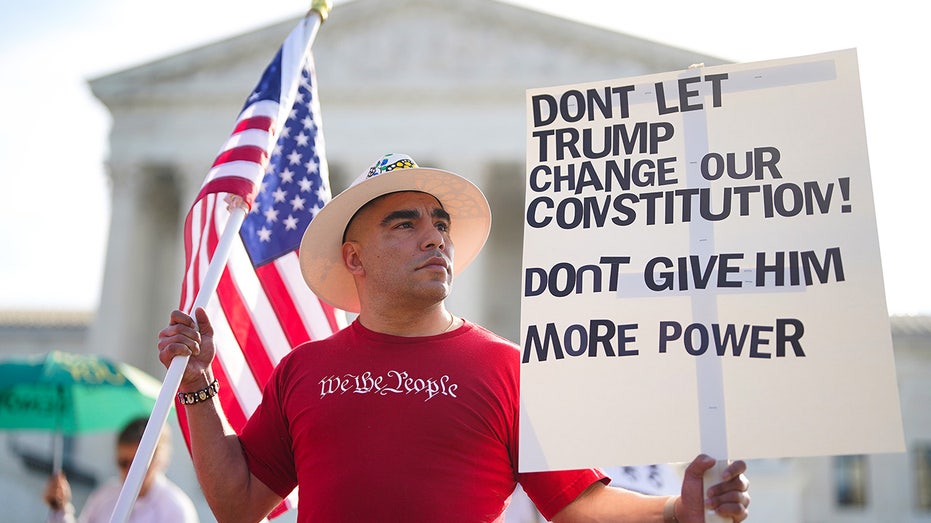





















A majority of Supreme Court justices on Wednesday appeared skeptical of President Donald Trump’s effort to end so-called birthright citizenship, using oral arguments to cite concerns over the legality and enforcement of an executive order that could reshape protections for millions of Americans.
At issue in the case, Trump v. Barbara, is the legality of an executive order Trump signed on his first day back in office, which seeks to end automatic citizenship for nearly all persons born in the U.S. to undocumented parents, or to parents with temporary non-immigrant visas in the U.S.
The high-stakes case brought into focus more than a century of executive branch action, Supreme Court precedent, and the text of the Constitution itself — or, more specifically, the Citizenship Clause of the 14th Amendment — which the administration argues has been misinterpreted in the more than 100 years since its passage.
President Donald Trump attended a portion of the oral arguments in person, making history and signaling just how closely he has been monitoring the issue.
Still, the majority of justices appeared poised to block Trump's order. In what proved to be a telling exchange, Chief Justice John Roberts told U.S. Solicitor General D. John Sauer shortly after arguments began that he viewed a key argument from the Trump administration as "quirky."
FEDERAL JUDGE BLOCKS TRUMP'S BIRTHRIGHT CITIZENSHIP BAN FOR ALL INFANTS, TESTING LOWER COURT POWERS
Roberts noted he was having a hard time making sense of the Trump administration's legal position on the 14th Amendment's exceptions to birthright citizenship, noting that they cite examples such as children of ambassadors, and children on warships, among other limited groups. "I'm not quite sure how you can get to that big group from such tiny and sort of idiosyncratic examples," Roberts said.
"We're in a new world now," Sauer told Roberts.
Sauer also argued that "8 billion people are one plane ride away from having a child who's a U.S. citizen,"
"It's a new world, but it's the same constitution," Roberts said in response.
The exchange previewed what proved to be an overarching reluctance from justices on the high court to allow the executive order to stand.
The doubts appeared to be shared by several conservative justices seen as key swing votes in deciding the case.
Justices Samuel Alito and Clarence Thomas appeared the most likely justices to side with Trump in the case.
"How much of the debates around the 14th Amendment had anything to do with immigration?" Thomas asked Sauer, noting that the amendment was designed to give newly-freed slaves citizenship, and not necessarily applied to children of newly arrived immigrants.
As expected, arguments focused heavily on precedent set in the 1898 Supreme Court case, United States v. Wong Kim Ark, which established birthright citizenship protections for persons "domiciled," or born on U.S. soil.
Justices Amy Coney Barrett, Brett Kavanaugh, and Neil Gorsuch appeared skeptical of the Trump administration's arguments, albeit to varying degrees.
They used their time to press Sauer on key issues centered on precedent, enforcement, and the text of the citizenship clause and laws passed by Congress.
Kavanaugh cited the passage of the 1952 Immigration and Nationality Act (INA), noting that it essentially mirrors the text of the 14th Amendment and text of the 1898 case.
"One might have expected Congress to use a different phrase if it wanted to try to disagree with Wong Kim Ark on what the scope of birthright citizenship, or the scope of citizenship, should be," he said, telling Sauer after a brief back-and-forth: "I am not seeing the relevance as a legal constitutional interpretative matter," he told Sauer, after a brief back-and-forth.
TRUMP TO BEGIN ENFORCING BIRTHRIGHT CITIZENSHIP ORDER AS EARLY AS THIS MONTH, DOJ SAYS
Shortly before arguments adjourned, Kavanaugh told the ACLU's lawyer: "If we did agree with you on Wong Kim Ark, that could be just a short opinion."
The case, he said, brings to the forefront questions about how laws should be read, and if they should be limited only to situations that lawmakers envisioned at the time of their passage, or whether they should be applicable in future situations, even if the situations were unimaginable at the time.
Alito pointed to an argument from his former colleague, the late Supreme Court Justice Antonin Scalia.
Scalia, he said, had "imagined an old theft statute that was enacted well before anybody conceived of a microwave oven. And then afterwards, someone is charged with the crime of stealing a microwave oven," he added. "And this fellow says, ‘Well, I can't be convicted under this, because the microwave oven didn't exist at that time.’"
"There's a general rule there, and you apply it to future applications," Alito said, to which Sauer emphatically agreed.
Thomas, though less vocal during arguments, also appeared to embrace the narrower reading of the 14th Amendment shared by the administration.
Justices also posed tough questions to the ACLU's legal director, Cecillia Wang, who argued the case on behalf of migrants. Their questions focused more on clarifying details, however, than they did on the underlying arguments.
Wang, for her part, argued Wednesday that birthright citizenship is "enshrined" in the 14th Amendment, and sets what she described as a "fixed, bright-line rule [that] has contributed to the growth and thriving of our nation."
"It comes from text and history. It is workable, and it prevents manipulation," Wang said. "The executive order fails on all those counts."
SUPREME COURT SIGNALS IT MAY LIMIT KEY VOTING RIGHTS ACT RULE
The oral arguments come as President Donald Trump has embraced a hardline posture on immigration enforcement in his second presidential term — including seeking to end birthright citizenship, an issue on which he campaigned on in his successful 2024 reelection campaign.
Trump's attendance underscored the importance of the case to him and marked the first time in U.S. history that a sitting U.S. president has attended arguments before the high court.
Clad in a red tie and dark suit, Trump was quiet for the duration of oral arguments — in accordance with strict Supreme Court rules — and appeared focused on the arguments made by Sauer. Attorney General Pam Bondi was also in attendance, as was Commerce Secretary Howard Lutnick.
Chief Justice John Roberts did not acknowledge Trump during arguments, and proceedings were otherwise conducted without fanfare or interruption.
Trump left the court shortly after Sauer presented his case, and did not comment publicly as he departed.
A ruling in Trump's favor would represent a seismic shift for immigration policy in the U.S., and would upend long-held notions of citizenship, which Trump and his allies argue are misguided. Critics argue that the order is unconstitutional and unprecedented — warning that, if implemented, it could impact an estimated 150,000 children born in the U.S. annually to noncitizens.
A decision from the high court is expected by late June.
The post Supreme Court skeptical of Trump birthright citizenship order, Roberts questions argument in landmark case appeared first on FOX News