






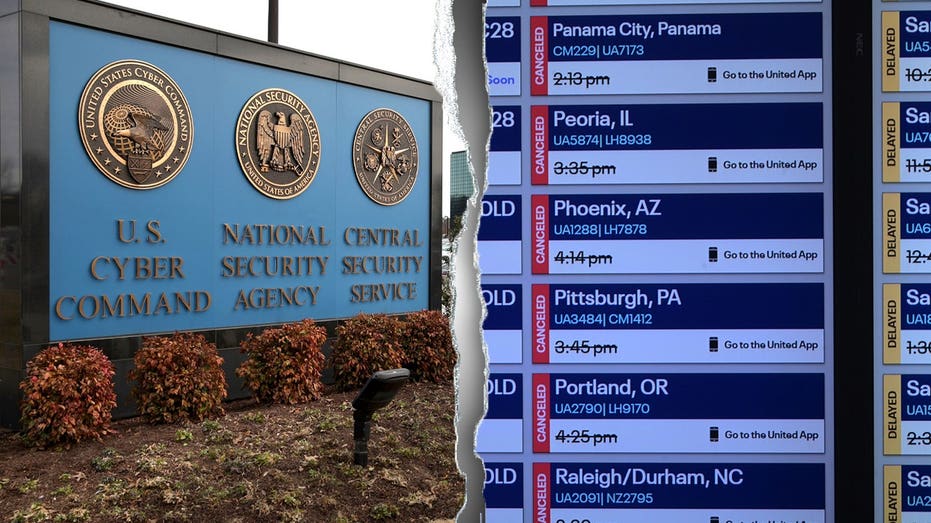













U.S. adversaries have spent years developing ways to disrupt the country's critical infrastructure in a conflict, and the wave of technology disruptions affecting everything from banks to the National Security Agency has offered a reminder of how detrimental those failures could be even without a cyberattack.
The string of outages has fueled speculation about whether the incidents are connected, though Trump administration officials have ruled out a coordinated cyberattack.
National security experts caution that while the outages do not establish malicious activity, they underscore the stakes of protecting systems that underpin everything from financial transactions to military operations.
TIMELINE: AMERICA HITS A TECH WALL AS OUTAGES CRIPPLE EMAIL, GROUND FLIGHTS AND DISRUPT MAJOR BANKS
"We know that our adversaries use that domain to attack our critical infrastructure," Tommy Waller, a national security expert with the Center for Security Policy, told Fox News Digital.
"Modern warfare, our people and our critical infrastructures are a prime target for all of our adversaries."
In a span of six days, technical disruptions affected Microsoft 365, commercial air travel, payroll and human resources software, banking transactions and the National Security Administration's highly classified internal communications network.
Some led to massive impacts on everyday life, including only the second-ever nationwide ground stop on all commercial flights since the September 11, 2001, terrorist attacks.
"This is not a cyberattack, and this is not a coordinated effort by a nation-state," Director of National Intelligence Jay Clayton said Tuesday on Fox Business' "The Claman Countdown."
Department of Homeland Security Secretary Markwayne Mullin similarly insisted the disruptions had "nothing to do with cyberattacks," suggesting that technical failures could become more common as new technology is introduced.
"I believe we're going to see more of this as new technology rolls out," Mullin said Tuesday. A day earlier, he sought to reassure Americans during an appearance on Fox News' "Hannity," saying, "Well, breathe. The homeland is secure. Our banking system is secure."
PRESIDENT TRUMP DOWNPLAYS PANIC OVER TECH OUTAGES: ‘NOBODY’S GOING TO PLAY GAMES WITH US’
But the disruption at the NSA, one of the nation's most sophisticated intelligence agencies, has drawn particular scrutiny.
The agency's highly classified internal communications network, known as NSA Net, went down Tuesday, disrupting employees' ability to communicate classified information internally. Employee attendance at the agency's Fort Meade, Maryland, campus was "staggered" throughout the week to ease systems' use, and the network did not resume operations until Friday.
"This latest thing at the NSA is more problematic because their systems are generally not tied to anybody else, particularly their classified ones," national security and cybersecurity expert Steve Bucci told Fox News Digital.
"And, so, that being coincidentally, you know, in this sequence makes it a little harder to just write off."
A U.S. official attributed the disruption to routine maintenance, saying the NSA experienced temporary interruptions to some internal systems but that its critical operations and national security capabilities remained fully functional.
Waller said the NSA outage could have been "self-induced" by efforts to patch vulnerabilities but questioned whether the broader string of disruptions was coincidental.
"The widespread and persistent nature of it and the types of infrastructures that are being targeted — appear to be targeted — that, to me, says that it's more than just a coincidence," he said.
Daniel Hoffman, a former CIA station chief and Fox News contributor, warned the institutions experiencing outages are already prime targets for foreign adversaries and cybercriminals.
"Every single one of these entities is a target, and so are you and I," Hoffman told Fox News Digital. "Every single day, 24 hours a day, China, Russia, North Korea, Iran, criminals, hackers are trying to target the banks. They're trying to target Microsoft, obviously."
Fox News Digital has reached out to the White House for comment.
The threat has already reached American infrastructure. In July, hackers targeted more than 30 municipal water systems in Minnesota, part of a broader wave of cyber intrusions across multiple states that forced some utilities to switch to manual operations and disrupted water service. Federal investigators examined possible Iranian involvement, though the attacks were not definitively attributed.
The Pentagon is also preparing for the possibility of widespread infrastructure failures during a major conflict. Under its FORTRESS initiative, military bases across the continental United States are being directed to prepare to sustain essential operations for at least 90 days without outside support, according to documents previously reviewed by Fox News Digital.
"We don't want to rely on standard civilian municipal infrastructure to run our national defense. We just simply can't. It's an intolerable risk," Pentagon chief spokesperson Sean Parnell previously told Fox News Digital.
Waller pointed to longstanding Chinese military writings that contemplate attacks on civilian communications and infrastructure during a conflict, arguing that the United States must consider the broader threat even when individual outages appear unrelated.
"Again, I am not saying that China did this. But if China wanted to, this is in their doctrine, right?" Waller said.
GROCERY STORE CYBERATTACKS ARE ‘PSYCHOLOGICAL WARFARE’ THAT COULD STRIKE US, FORMER FBI AGENT WARNS
In 2024, U.S. intelligence and law enforcement agencies warned that Chinese state-sponsored hackers known as Volt Typhoon had infiltrated American communications, energy, transportation and water systems, positioning themselves to potentially disrupt critical services during a conflict with the United States.
New research published last month found that the group had continued targeting government, defense and critical infrastructure networks through a separate hacking operation, even after U.S. authorities moved to dismantle parts of its infrastructure.
Bucci, however, noted that an adversary seeking to compromise American infrastructure might have little incentive to cause widespread, visible failures that could expose its activities.
"They might want to go in and do things to implant stuff for later use," Bucci said when asked whether foreign adversaries could be testing vulnerabilities in critical U.S. infrastructure.
"But you usually don't do a weight test where you make stuff fail or get glitchy because that can then warn the target," he added.
The disruptions have also prompted calls for greater transparency from federal officials and private companies responsible for critical systems.
"For our economy to function, people need to have some confidence in banks, among other things," Hoffman said. "So, kind of need to tell us what's going on."
Waller also urged greater transparency about infrastructure vulnerabilities and the steps being taken to address them.
"Number one, just tell the truth and be transparent," Waller said.
The post Tech outage cascade exposes US vulnerabilities to foreign cyber threats appeared first on FOX News