

















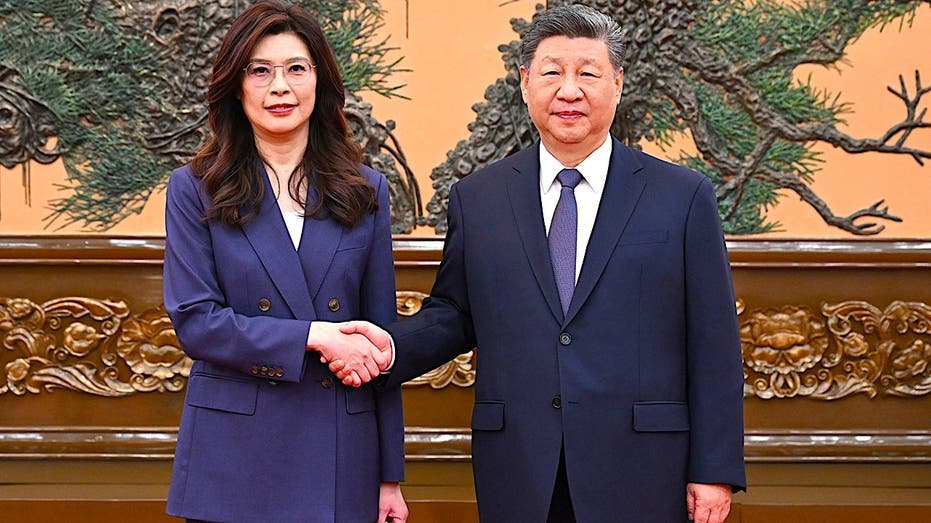





















KAOHSIUNG – Taiwan: For the first time in nearly a decade, the People’s Republic of China (PRC) supreme leader and the head of the communist party, Xi Jinping, held a meeting with the chairperson of Taiwan’s main opposition party. Cheng Li-wun, chairwoman of the Chinese Nationalist Party (also known as the Kuomintang, KMT), met Xi in Beijing on Friday.
Before their closed-door meeting the pair posed for pictures. Xi said that Taiwan is historically a part of China and remains an "inalienable" and "inseparable" part of Chinese territory. He said the "rejuvenation of the Chinese nation" was a "broader trend" that will not change. China’s state-controlled media and government officials often repeat these party lines, even though, after its establishment in 1949, the communist regime has not ruled Taiwan for a single day.
The two met in their capacities as heads of their respective political parties. China refuses to speak to the democratically elected government of Taiwan, led by President Lai Ching-te of the Democratic Progressive Party (DPP). The DPP won Taiwan’s presidential elections in 2016, 2020, and 2024, although in 2024 it narrowly lost control of the parliament to an opposition coalition led by the KMT.
TAIWAN 'WILL NOT ESCALATE, BUT WILL NOT YIELD' TO CHINESE INTIMIDATION, FOREIGN MINISTER WARNS
The meeting came as Taiwan is mired in a dispute over defense spending, with the opposition coalition blocking President Lai’s proposed $40 billion special defense budget. During a recent visit to Taipei, Sen. Jim Banks, R-Ind., said approval of the package would send a clear message that Taiwan is prepared to invest in its own defense and "peace through strength."
Hours before Cheng and Xi smiled for the cameras, Lai did not directly mention the Beijing meeting, but said on social media that any compromise with an authoritarian regime would damage Taiwan’s sovereignty. There are also concerns that if the special budget isn’t approved soon, the willingness of President Donald Trump to sell weapons to Taiwan could change should Trump decide to strike some kind of deal with Xi at a possible meeting in May.
Xi’s phrase "rejuvenation of the Chinese nation," which was repeated by Cheng, is a reference to the goal of China becoming a — if not the — major world power by 2049, the centennial of the founding of the communist PRC.
In comments that are sure to evoke controversy in Taiwan, Cheng repeated much of Xi’s phrasing, claiming that in the more than 100 years of interactions between the KMT and the CCP, "all we ever wanted is to guide the Chinese nation out of decline and toward rejuvenation." Cheng went on to say, "The great Chinese rejuvenation involves people on both sides of the strait. It is about the reawakening and resurgence of Chinese civilization."
That’s not how many here in Taiwan see things. Rose Chou, 45, works as an administrator in one of the biggest primary schools in Kaohsiung, southern Taiwan’s largest city and a major port. Chou told Fox News Digital it was time for Taiwan to dump any connection to being China or a part of China. "Yes, I want a Republic of Taiwan. I have an 18-year-old son. And, yes, I realize we may have to fight. I’m willing to fight."
US LAWMAKERS WARN TAIWAN TO ‘MEET THE MOMENT’ AS CHINA STAGES INVASION-STYLE DRILLS
Chou readily admitted that most people she knows favor maintaining the status quo. A very small number, she said, are committed to the idea of unification — but under what terms they hope that could occur, Chou said she didn’t know.
Under the status quo that dates from the end of the Chinese civil war in 1949, Taiwan’s official name remains the Republic of China, to nominally indicate that Taiwan is a part of China, just not "Red China." This formula previously satisfied the communist regime in Beijing, but — especially since Xi Jinping’s rise — Beijing has pushed Taiwan towards outright submission.
A meeting between the head of the KMT and the CPP hasn’t happened in almost a decade, but there is precedent. A KMT chair met Xi in 2015, and again in 2016, and separately, in 2015, then-Taiwan president Ma Ying-jeou met Xi in Singapore, during which each addressed the other as "Mister," and titles used were "Leader of Taiwan" and "Leader of Mainland China," respectively.
In a statement after the meeting, a spokesperson for the American Institute in Taiwan, the de facto U.S. embassy in Taipei, said, "The United States supports cross-Strait dialogue. We expect cross-Strait differences to be resolved by peaceful means, free from coercion, in a manner acceptable to the people on both sides of the Strait. Meaningful cross-Strait exchange should focus on dialogue between Beijing’s leadership and Taiwan’s democratically elected authorities without preconditions, while also including engagement with all other political parties in Taiwan."
Elizabeth Freund Larus, a Taiwan Fellowship Scholar in Taipei, told Fox News Digital the KMT’s traditional China approach no longer connects with much of Taiwan’s electorate. "KMT Chair Cheng’s trip is trying to replicate Ma Ying-jeou’s approach to cross-Strait relations," Larus said. "But that approach is 30-years old and no longer appeals to the Taiwanese. As a result, many people in Taiwan are critical of her China trip."
Larus said Beijing is also likely to use the visit for domestic propaganda, presenting it as proof that Taiwan embraces cultural and social affinities with mainland China while casting the government in Taipei as an outlier. "Cheng may be welcomed in Beijing," Larus said, "but her party may receive a less enthusiastic reception" in local elections later this year and in the next presidential and legislative elections in 2028.
Taipei-based political risk analyst and Tamkang University assistant professor Ross Feingold told Fox News Digital, "President Lai’s DPP has a savvy media team, which for many years has successfully shaped public opinion towards China. Following today’s meeting, Cheng and the KMT will be portrayed as traitors willing to sell out Taiwan."
He concluded by noting, "Ultimately, though, the success or failure of Cheng’s visit to China and meeting with Xi will be determined by Taiwan’s voters, despite efforts from China and the United States to influence events. For the Trump administration, though, its near-term priority in Taiwan remains legislative approval to purchase billions of dollars of American weapons and speedy implementation of Taiwan’s commitment to invest $250 billion in the United States."
The post Taiwan opposition leader meets Xi in Beijing as Taiwan defense fight intensifies appeared first on FOX News