


































- Jeff Weniger sees a buying opportunity after the Iran-war-driven sell-off.
- He highlighted the VIX hitting 30, indicating the type of peak market uncertainty that happens near bottoms.
- Weniger also pointed to rising S&P 500 earnings estimates and high pessimism around a war resolution.
Dip-buying has begun in earnest after a rocky few weeks for stocks that saw the S&P 500 fall as much as 9%. One Wall Street strategist says it's right on cue.
Stocks ripped on Tuesday on the prospect of cooling tensions between Iran and the US, with the S&P 500 and Nasdaq 100 indexes rising 3% or more.
But equity market has been unpredictable, and the S&P 500 is still down 6% since the start of the war. What makes now an attractive time to get back in the market?
Jeff Weniger, the head of equity strategy at WisdomTree, highlighted a trio of factors on Tuesday in an interview with Business Insider.
3 reasons to buy the recent dip
- S&P 500 earnings estimates were revised upward in March
With the market tanking in recent weeks as oil prices have soared, one might be surprised to hear that Wall Street consensus forward earnings estimates for the S&P 500 were actually revised upward in March.
So, with the fundamental outlook for earnings even stronger than a few months ago, but the market down, it starts to look like a buying opportunity, he said.
"Just a few weeks ago, we were at 7,000, and the consensus was like $310, $312, $315" for earnings per share on the S&P 500, he said. "Now we're at 6,400, and we're looking at $323."
- The VIX has gotten extended
The CBOE Volatility Index, or VIX, measures investors' expected volatility for the S&P 500 in the months ahead. When the market dips, the VIX tends to spike.
On Monday, the VIX reached 30, which Weniger said is a level that starts to signal peaking uncertainty in the market, meaning a bottom is near.
<script type="text/javascript" defer="" src="https://datawrapper.dwcdn.net/fE8RK/embed.js" charset="utf-8" data-target="#datawrapper-vis-fE8RK"></script><noscript>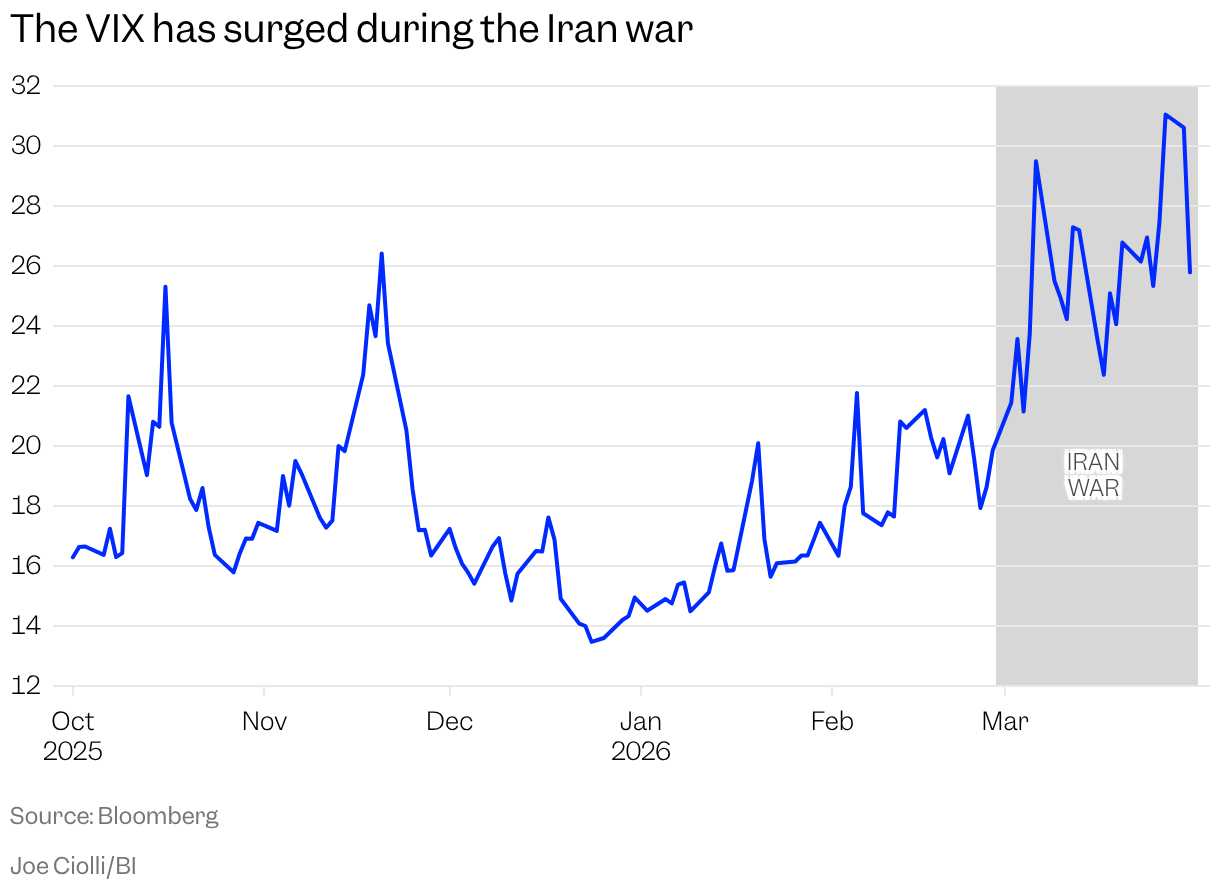 </noscript>
"When the VIX is north of 30 and you go long big, broad exposures or put risk on in some capacity, you generally come back three, six, nine months later not regretting it," he said. "You put it on on a Tuesday, you might regret it by Thursday or Friday, but usually you're pretty close" to the low, he added.
- Investors have been underpricing a war resolution
Weniger thinks investors have been too pessimistic about a potential resolution to the Iran warn, and this has caused them to misprice a few related risks.
One of them is how high oil prices stay. Expectations have been skewed more to the probability that oil prices move higher rather than lower, he said, meaning there's room for upside in stocks when those expectations adjust.
He cited Bank of America's most recent Fund Manager Survey, which showed that just 4% of respondents saw Brent crude prices at below $60 a barrel by the end of 2026. Most saw it in the $60-80 range, with some projecting higher. As of Tuesday afternoon, Brent crude stood at around $104 a barrel.
"Sixty bucks is where we were in recent memory," Weniger said, referencing crude oil price levels as recently as January. "It doesn't even need to be our base case, it just needs to be more probable than consensus."
Two risks tied to oil prices are stagflation and higher interest rates, and the market's dour view on the conflict has amped up fears of these outcomes, Weniger said.
Stagflation would take months or years to materialize, he said, so worrying about it after a month is far too premature.
On rates, Weniger said the economy is not nearly hot enough to justify a hike amid fairly timid loan growth, and said the Federal Reserve is more likely to cut rates as its next move.
"I still do think that the path of least resistance for the Federal Reserve is to cut rates," he said. "That's materially different than what a lot of people are suspecting, so to the extent that they surprise dovish, that is something that would help."
The post 3 reasons why now is the time to buy the Iran-war-driven dip in stocks, investment strategist says appeared first on Business Insider