


- Tech stocks have driven gains for the broader market for the past couple of years.
- But leadership has completely rotated since last week's Fed decision.
- Here's what the situation means for investors as they prepare for the November jobs report.
For the last couple of years, the stock market has been like the 1990s-era Chicago Bulls.
Major indexes have repeatedly set record highs, similar to how the Bulls repeatedly won the NBA title during that period, collecting six trophies in eight years.
A heavy concentration of stock gains have been in an elite group of seven "magnificent" tech companies, most notably Nvidia, the most valuable company of all time. The 90s Bulls, meanwhile, were primarily driven by Michael Jordan, the greatest basketball player of all time.
But since last week's Fed meeting, stocks have been behaving like a different championship-winning team: the 2004-05 Detroit Pistons, a well-assembled, diversified team with no clear superstar.
In market terms, that is to say stocks have been getting contributions from all over, with no single area accounting for most of the move. It's been a team effort to get stocks back near record highs.
The chart below shows the dynamic in action. Since the day before the Fed's rate-cut decision, defensive sectors like materials, healthcare, and financials have soared, while the two main tech sectors have brought up the rear.
<script type="text/javascript" defer="" src="https://datawrapper.dwcdn.net/fTTBB/embed.js" charset="utf-8" data-target="#datawrapper-vis-fTTBB"></script><noscript>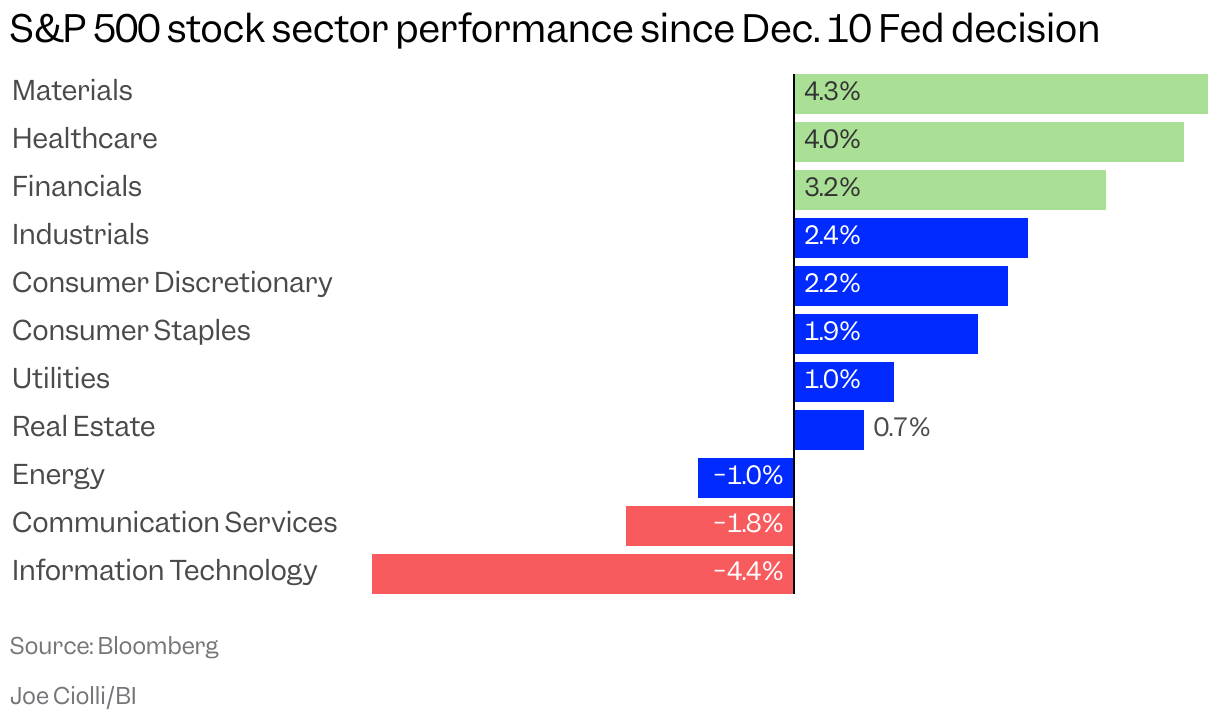 </noscript>
That right there is a good, old-fashioned rotation. Underpinning the sudden flip-flop of market leadership is the expectation that the economy will expand going forward.
The Fed offered a strong signal in support of that at its pivotal meeting last week, raising its economic-growth forecast for 2026 by half a percentage point. Expectations of resilient growth have also fueled bullish stock-market projections for Wall Street firms like Morgan Stanley and
Deutsche Bank.
This type of rotation — and the broadening out of gains across more stock sectors — is important for the longevity of any bull market. And while it's only been happening for about a week, it's worth asking whether it can be a long-term shift.
Today's jobs report will be an immediate test of that.
If labor-market data from November comes in strong, that would throw weight behind a sustained economic recovery, and therefore favor the more cyclically linked areas of the market pacing gains in the above chart.
Conversely, in the case of a weak report, stocks could still be fine, because odds of another rate cut would likely rise. In this scenario, tech would probably regain its footing as the dominant area.
Everyday investors who follow the market at the index level are unlikely to care whether the stock market is channeling the 90s Bulls or the 2005 Pistons. But closer watchers will be monitoring whether the ongoing rotation is a flash-in-the-pan anomaly or the new gold standard of winning.
The post There's a Great Rotation underway in stocks. Here's what it means for investors. appeared first on Business Insider