








- New tools from Anthropic tanked software stocks on Tuesday, with investors fearing more disruption from AI.
- Software stocks have wobbled for months, and the sector officially entered a bear market last week.
- These three charts illustrate the steep declines for software stocks in the last year.
Anthropic's new AI tools clobbered software stocks on Tuesday, but the AI titan's Cowork update was just the latest headwind for the beleaguered corner of the tech sector.
Software stocks are mired in their worst sell-off since the "Liberation Day" market crash, with the sector officially entering a bear market last week after Microsoft's earnings fueled more concern about valuations and growing AI capex.
The selling gained steam on Tuesday as investors panicked about Anthropic's new AI tool, which can perform a range of clerical and administrative tasks for people working in the legal industry. Legal software stocks got crushed, but the selling spilled over into the broader space by the end of Tuesday's session.
The decline reflects two fears that are top of mind for investors: On the one hand, tech stocks are broadly expensive and fears of an AI bubble still loom over markets.
On the other hand, there is great uncertainty as to how the business model for software companies could change, Craig Johnson, a managing director and chief market technician at Piper Sandler, told Business Insider.
Investors are mulling the extent to which these are existential threats to certain companies or if they'll somehow ultimately adapt to new realities.
"Investors believe that ultimately, look, if three years from now you're going to be sitting on your desktop asking your desktop to generate code to do certain things for you, it's impossible to believe that there won't be benefits for customers removing some of the software," Adam Parker, the founder of Trivariate Research, said.
"I think it's just a manifestation of the worries that market participants have had for quite some time," Michael Brown, a senior research strategist at Pepperstone, added about Tuesday's big sell-off.
Yet, the latest weakness in the space is a continuation of what's been a year of weakness for software names.
Here are three charts that show how striking the decline has been.
Software bear market
Software stocks officially entered a bear market last week. The iShares Expanded Tech-Software Sector ETF is now 27% from its September 2025 peak.
Valuations are plummeting
<script type="text/javascript" defer="" src="https://datawrapper.dwcdn.net/2lLNA/embed.js" charset="utf-8" data-target="#datawrapper-vis-2lLNA"></script><noscript>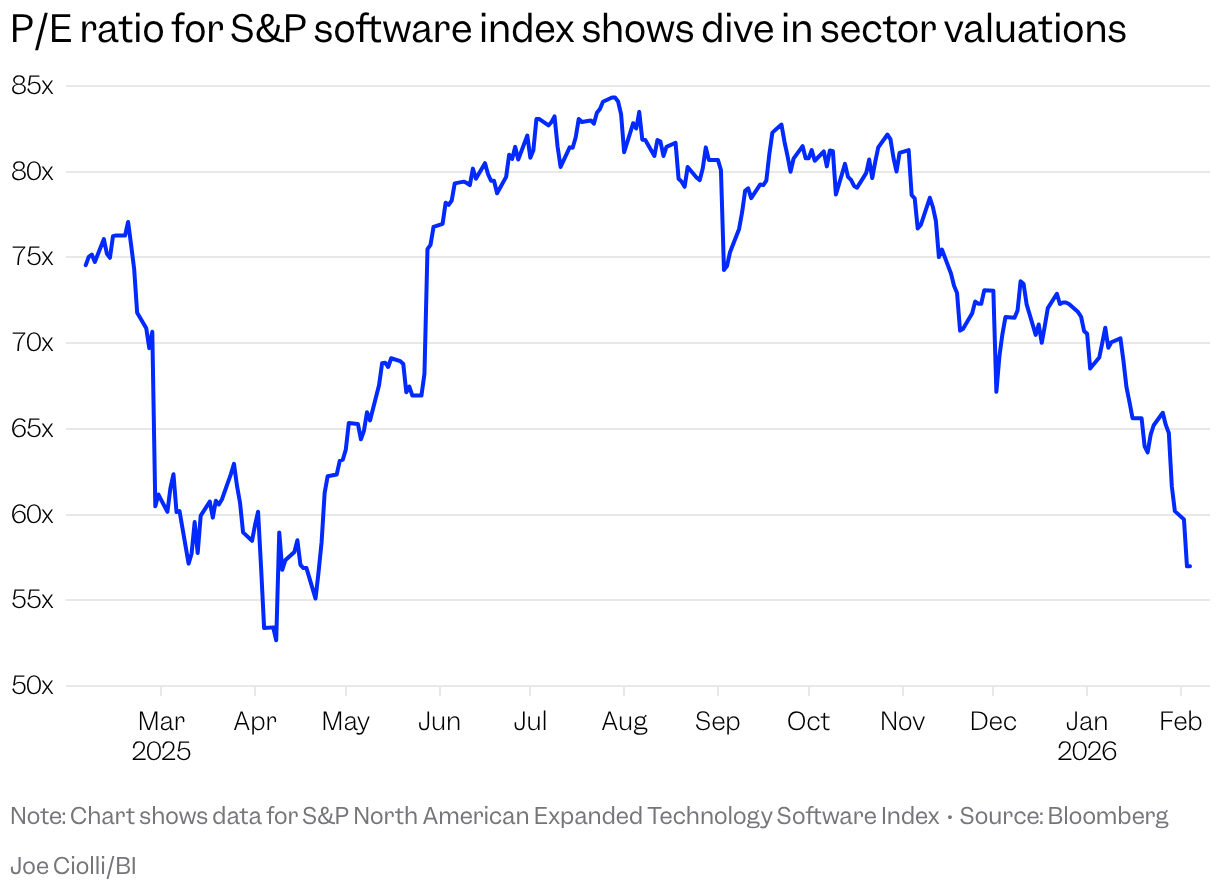 </noscript>
The price-to-earnings ratio, a traditional measure of stock valuations, has also dropped sharply among software makers' stocks. The P/E ratio in the S&P software index has dropped to below 60x, down from a peak of around 85x last summer.
Worst-performers
<script type="text/javascript" defer="" src="https://datawrapper.dwcdn.net/x1AjC/embed.js" charset="utf-8" data-target="#datawrapper-vis-x1AjC"></script><noscript>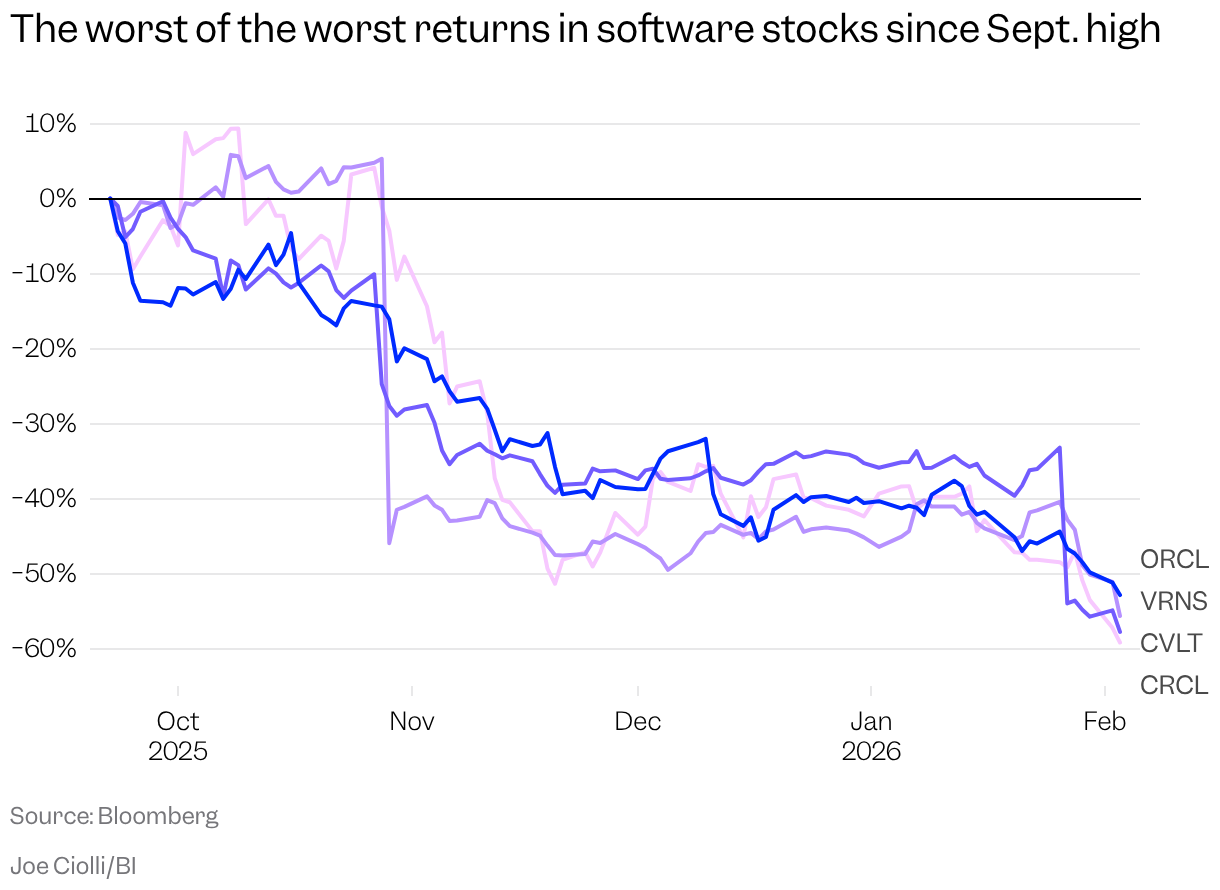 </noscript>
Oracle, Varonis, CommVault, and Circle make up the group of the worst-performing stocks in the sector. All four stocks are down more than 50% from their September highs.
The outlook for software on Wall Street looks mixed after Tuesday's rout.
Pepperstone's Brown said he believes the bull case for tech broadly is still "very, very robust," pointing to strong earnings and expectations for solid economic growth in the US. The S&P 500 is on track to post 12% earnings growth for the fourth quarter, which would mark its fifth straight period of double-digit growth, according to FactSet.
"I'm still very much in buy-the-dip mode," Brown said. "Overall you are looking at a market where the path of least resistance leads higher."
Most software stocks have more room to fall from a technical perspective, Piper Sandler's Johnson said. He pointed to the relative strength index, a technical gauge used to predict the near-term direction of stock prices, and said he believed most software names had at least 10%-20% more downside to go before finding a floor.
"CRM, ServiceNow, Oracle, DataDog, Snow, doesn't really matter," he said. "They all have not pulled back or corrected to identifiable support levels."
Adam Parker, the founder of Trivariate Research, said he believed software would be stuck in a "guilty until proven innocent mode," with investors punishing companies until they saw stronger earnings growth.
"What the market's telling you is that the analyst estimates are way too high," he said of earnings. "I feel like it's a falling knife that I don't want to catch personally."
The post The monthslong wipeout in software stocks, in charts appeared first on Business Insider