











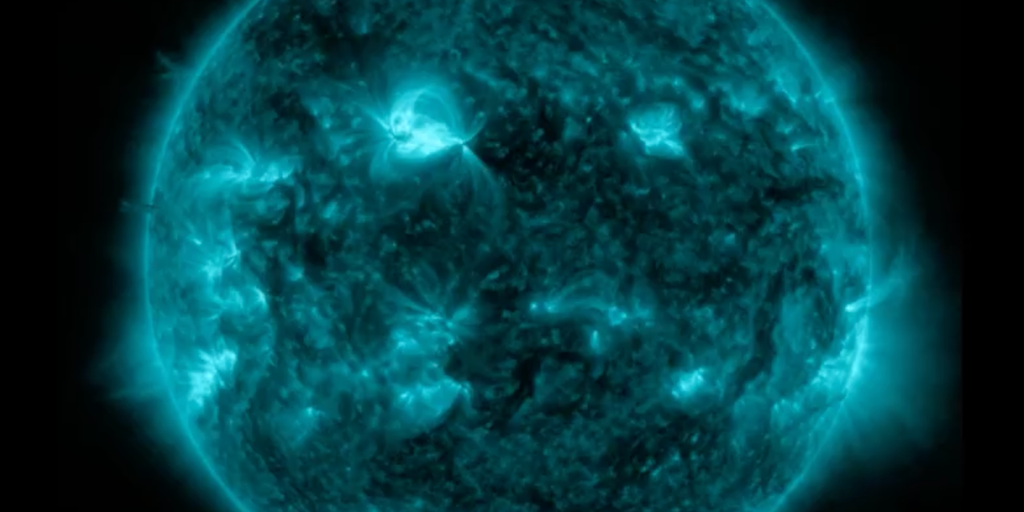



The Sun released a strong solar flare on Tuesday, Feb. 3, following several eruptions in the preceding days, prompting increased geomagnetic storm activity.
NASA’s Solar Dynamic Observatory captured the event, classifying it as an X1.5 flare.
According to NASA, the flare peaked at 9:08 a.m. ET and X-class denotes the most intense flares, while the number provides more information on its strength.
A solar flare is a sudden release of energy from the Sun that often appears as a localized burst of bright light.
NASA states that solar flares occur when built-up magnetic energy in the Sun’s atmosphere is rapidly released, emitting radiation across nearly the entire electromagnetic spectrum.
Solar flares are the largest explosions in the solar system. The energy released by one solar flare in one second is 10 million times more powerful than the energy released by a volcanic eruption.
"When a solar flare erupts, the explosion can release as much energy as a billion atomic bombs," NASA said.
BACK-TO-BACK SOLAR STORMS HEADED FOR EARTH COULD CREATE DAZZLING AURORAS, POWER GRID FLUCTUATIONS
These types of events, such as flares and solar eruptions, can also impact radio communications, electric power grids, navigation signals, and pose risks to spacecraft and astronauts.
According to NOAA and NASA, when the Sun releases energetic particles and magnetic material — especially from coronal mass ejections (CMEs) associated with solar flares — these particles and fields can interact with Earth’s magnetic field, drive geomagnetic storms, and enhance the brightness and extent of the Northern Lights.
In late January, a strong geomagnetic storm gave millions the rare opportunity to see the Northern Lights.
SEVERE GEOMAGNETIC STORM DAZZLES NIGHT SKY WITH NORTHERN LIGHTS IN MANY STATES ACROSS US
Based on NOAA Space Weather Prediction Center and NASA observations of solar activity, recent X‑class flares from AR4366 could produce geomagnetic disturbances that could enhance the Northern Lights.
The post See it: NASA captures strong X-class solar flare from Sun fueling potential for enhanced auroras appeared first on Fox Weather