

























- The US could be headed for a serious downturn next year, economist David Rosenberg says.
- Rosenberg thinks the economy will stall as fiscal and AI-related stimulus declines.
- Should the stock market drop sharply, that could be enough to trigger the recession, he predicted.
One of the most-predicted US recessions in history could be around the corner, according to the economist who's been eying the risk of a downturn since 2022.
David Rosenberg, a top economist and the president of Rosenberg Research, said he thinks the US economy could be on track to tip into a serious contraction sometime in 2027, ending its defiantly strong run over the past several years. That's because the US looks poised to run out of two sources of dry powder that have been key to staving off a recession: large fiscal stimulus and the billions being poured into AI, he told Business Insider in an interview.
"We could have a very significant recession in 2027 because business spending will face a vacuum," Rosenberg said.
He added that, after Americans receive their tax refunds this year, the economy could have a "lifeline" of two to three months before potentially seeing more serious issues.
Fiscal and AI-related stimulus have been key to powering the economy in recent years. For one, the US got a substantial boost from President Trump's One Big Beautiful Bill, which extended the 2017 tax cuts and introduced a slate of other fiscal policies aimed at stimulating the economy. Over the long run, the bill was expected to boost GDP by 1.2 percentage points, according to an estimate from the Tax Foundation.
But Rosenberg thinks that stimulus comes into jeopardy after the midterm elections this November, referring to the likelihood that Democrats will take control of Congress. That means it's more likely lawmakers could be in gridlock over the next two years — an issue that means the stimulus propping up economic growth could be a "no-show" in 2027, he speculated.
Meanwhile, AI-related spending looks on track to peak sometime this 2026, Rosenberg said, pointing to the billions tech stalwarts have already poured into data center construction. Amazon, Google, Meta, and Microsoft, four giants at the heart of the AI boom, are projected to spend nearly $600 billion in AI-related capex this year, according to a Business Insider analysis of company statements.
<script type="text/javascript" defer="" src="https://datawrapper.dwcdn.net/yzm3p/embed.js" charset="utf-8" data-target="#datawrapper-vis-yzm3p"></script><noscript>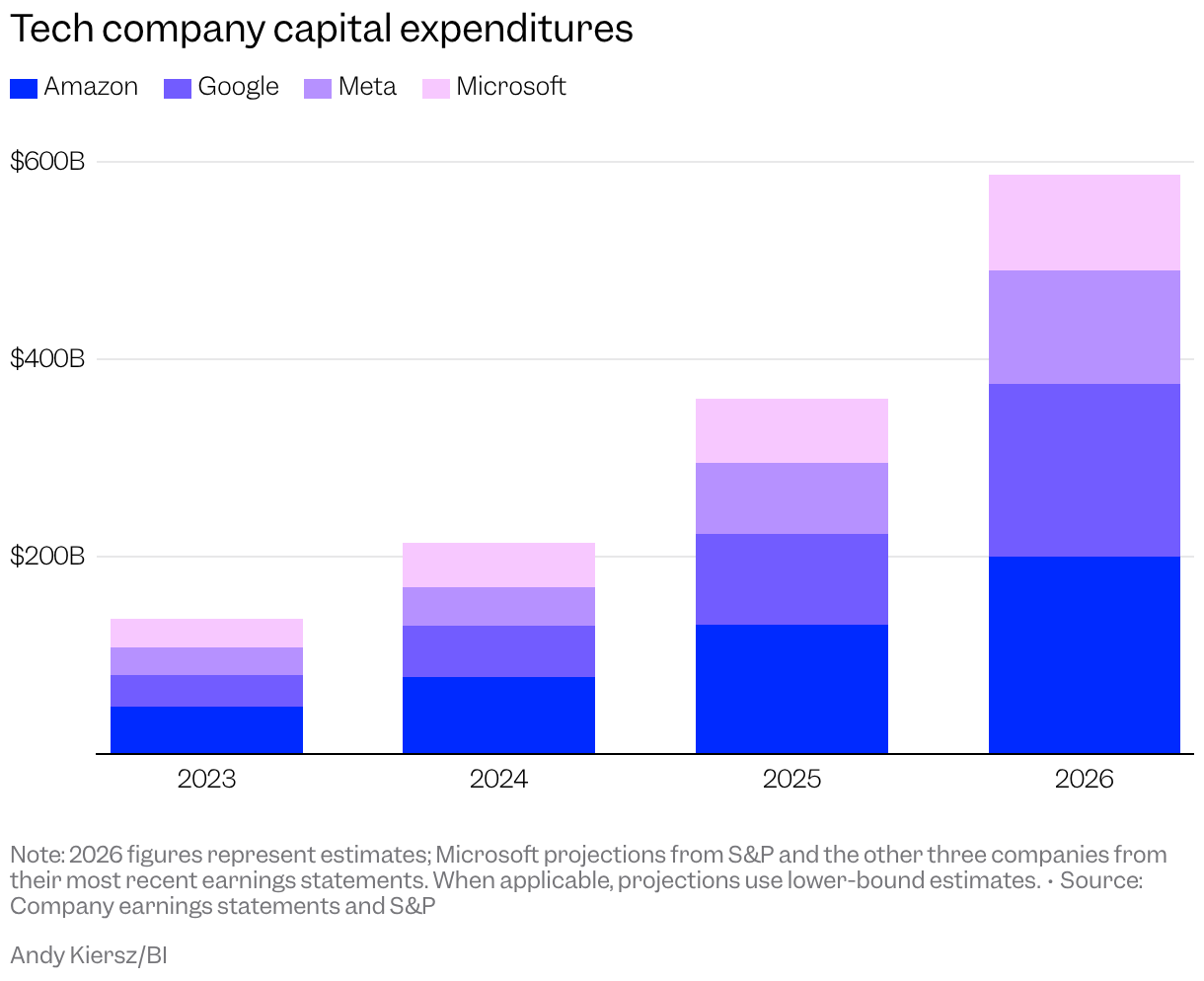 </noscript>
Rosenberg estimated that AI capex has likely driven around 90% of all economic growth in recent years, when accounting for the wealth effect from the rise in tech stocks.
"We're going to be removing two crutches next year," Rosenberg said. "Enjoy the capex boom while it lasts."
Fiscal and AI-related support drying up would take out a key measure of support for the economy at a time when growth looks more fragile. Real GDP grew at an annualized 1.4% pace over the fourth quarter, according to the Bureau of Economic Analysis, compared to the 4.4% yearly pace the prior quarter.
Americans also look to be under greater financial pressure. Hiring has slowed significantly in the past year, while layoffs have climbed.
The personal savings rate, a gauge for consumer health, dropped to 3.6% at the end of last year, down 150 basis points from the start of 2025.
If the stock market were to see a meaningful correction and diminish the so-called wealth effect, that could cause consumers to pull back further on spending and trigger a recession, Rosenberg said.
"No job growth, no income growth," he said. "Imagine if people were forced to tighten their belts and spend money in line with their real incomes."
Recession warnings and predictions of stagflation have started to trickle back into the conversation on Wall Street amid the volatility spurred by the Iran war.
The post A top economist says he sees a 'very significant' recession coming in 2027 as fiscal stimulus and AI capex dry up appeared first on Business Insider