









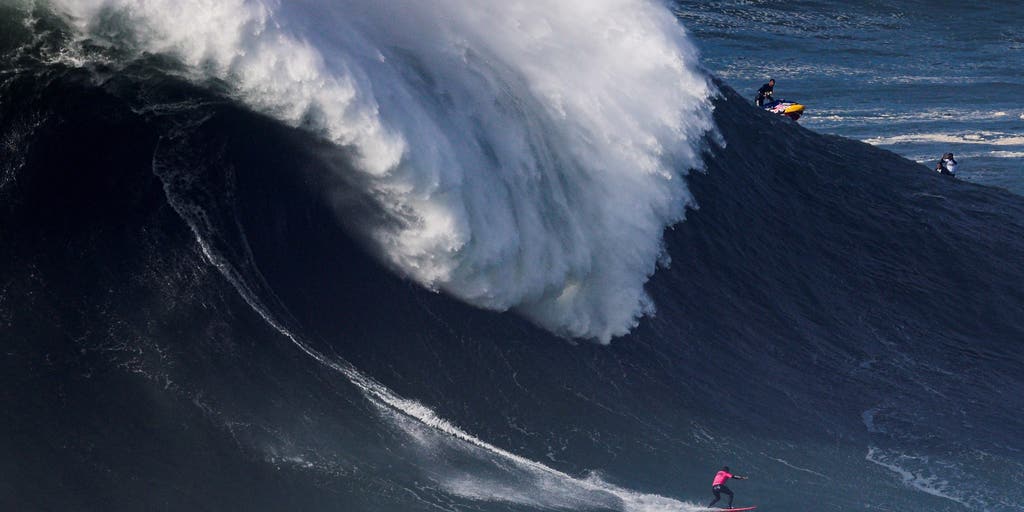
NAZARÈ, Portugal – Off the coast of Portugal, a quiet fishing village has progressively evolved into the premier venue for big wave surfers looking to catch the wave of a lifetime.
For decades, thrill seekers from around the globe have flocked to the Portuguese coastal town of Nazaré. Not only to enjoy the stunning beaches, local cuisine and Portuguese culture, but to try to conquer one of the biggest waves Earth has to offer.
The dangerous world of big wave surfing is defined by a number of unique and remarkable waves around the globe, and arguably none are more notable than Nazaré.
When the stars align and the waves at Nazaré are breaking biggest, peaks can range anywhere from 80 to 100 feet in size depending on the conditions.
The sheer size and force of Nazaré's biggest waves are too big for any surfer to paddle into alone.
Surfers brave enough to attempt to conquer one of the world's biggest and strongest waves on a fateful day must get towed in by a jetski in order to catch the massive wave.
Overlooking one of the world's greatest showcases of the power of the ocean is the Forte de São Miguel Arcanjo and Nazaré lighthouse, which serves as a perfect location for spectators looking to catch a glimpse of the colossal wave in all its glory.
Year after year, professional big wave surfers from around the world flock to the area when the wave is forecast to break biggest.
While the eyes of the world are enamored by the magic of Nazaré above the water, it is the features underneath that are responsible for producing the beastly 100-foot waves.
Massive swells born in the North Atlantic Ocean assemble in the deep depths of an underwater canyon, and eventually target all of their energy towards Nazaré, where a perfect storm of natural variables clash, and spawn the arena that big wave surfers like Garrett McNamara, Kai Lenny and Sebastian Steudtner live for.
Just off the coast of Praia do Norte beach in Nazaré is the largest underwater canyon in Europe that serves as a funnel because it rapidly magnifies swell that travels across the Atlantic Ocean before breaking off of the coast of Portugal at Nazaré.
The Nazaré Canyon is over 100 miles in length and at its lowest point reaches depths of over 4,500 meters. When conditions align, the canyon naturally produces the colossal waves that have made Nazaré a household name in the surfing world.
As waves travel toward Nazaré through the canyon’s varying depths, the bathymetry of the seafloor becomes the key factor in the formation of one of the biggest rideable waves on the planet.
When the stars align, waves traveling towards the Portuguese coast interact with the Nazaré Canyon at the right angle at the right timing, and set the stage for one of the most impressive natural phenomenons Earth has to offer.
Waves traveling over the deep canyon gain energy and grow extremely powerful, before a fateful meeting with nearby waves over shallow depths, causing the waves to rapidly gain size and strength before thunderously clashing in shallow water, which then triggers the monster waves to violently break in a Herculean fashion.
Like every big wave, conditions are of the utmost importance. Nazaré isn't always packing the mountains of water that attracts brave surfers from around the world to attempt to conquer.
The swell direction, wind, tide and swell period are among the primary variables when forecasting if Nazaré is going to produce the rolling mountains of the ocean, which currently hold the record for the biggest wave ever ridden.
HOW WEATHER IMPACTS WAVES DURING SURFING COMPETITIONS
When a powerful Atlantic swell approaches Nazaré at the proper angle, the ocean wave uses the canyon as a booster and produces the humongous waves that put the coastal town on the map.
For surfers, forecasting is everything. Competitions annually draw the best of the best big wave surfers to Nazaré to participate in competitions, and being able to predict when the wave is going to break at its best and biggest is essential.
Big wave season at Nazaré typically runs from October to April, the peak time for strong storms to travel through the Atlantic Ocean towards Europe.
FLORIDA SURFER, 72, RESCUES FATHER AND SON FROM RIP CURRENT IN NEW SMYRNA BEACH
Each year, the World Surf League hosts the Nazaré Big Wave Challenge with an open window from November to March, a one-day event that invites the world's best professional big wave surfers to try their luck clashing with the titans off the coast of Portugal.
The largest wave ever surfed and confirmed by the World Surf League belongs to Sebastian Steudtner, who caught a measured 86-foot (26.21m) wave at Nazaré in February 2024.
Though there are unofficial claims of surfers catching waves over 100 feet, the mark has never been confirmed in the strict authentification and measurement process done by the World Surf League, and adopted by the Guiness Book of World Records.
WATCH: 40-FOOT WAVES SLAM OAHU BEACH AS HAWAII'S 'THE EDDIE' SURF COMPETITION UNDERWAY
Praia do Norte at Nazaré holds the top three spots for the biggest waves ever authenticated by the World Surf League and the Guiness Book of World Records.
With hundreds of surfers aiming to be the ones to catch the fabled 100-foot wave, there's a good chance that when the day comes, with the right conditions, Nazaré will be the wave it happens at.
The post How the biggest waves in the world break off the coast of Portugal appeared first on Fox Weather