







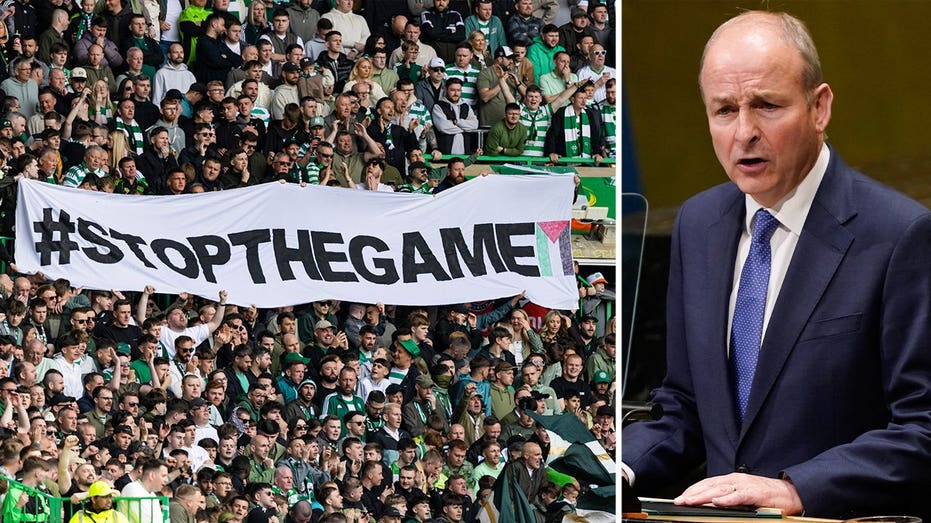













Irish Prime Minister Micheál Martin rejected claims that Ireland's sharp criticism of Israel has crossed into antisemitism as tensions flared around a politically charged soccer match between the countries Sunday, with Irish players holding a last-minute vote over whether to boycott the game.
Martin, in an exclusive interview with Fox News Digital this week in New York, outlined why Ireland has taken such a staunch position against the Israeli government's conduct of the war in Gaza, calling its military response "absolutely disproportionate" while pressing Israel to "change strategy" and calling for increased humanitarian aid to Gaza.
Martin argued that Ireland's own history — particularly its experience ending decades of conflict in Northern Ireland — gives the country a role to play as a voice for peace on the international stage, a theme he returned to while discussing Ukraine and the ongoing debate over Irish reunification.
"I think for the vast majority of people it does not," Martin said when asked directly whether anti-Israel sentiment in Ireland had crossed the line into antisemitism.
"We have no toleration for antisemitism, none," Martin added.
The extraordinary player vote came after months of pressure surrounding the UEFA Nations League fixture on Sunday, with more than 160 Irish sports figures calling for a boycott and players themselves publicly questioning whether the match should go ahead.
A "significant majority" of players ultimately voted on Saturday to play the game, while one player left the squad after expressing his wish not to take part.
In the interview, Martin strongly condemned Hamas' Oct. 7 terrorist attack and defended Israel's right to exist in security.
"First of all, we condemned, absolutely, the outrageous terrorist attack by Hamas in October," Martin told Fox News Digital.
"We believe in a two-state solution," Martin said. "We believe that Israel, of course, has a right to exist in security and its people need to be guaranteed of security. But likewise, Palestinians should have a right to live in their homeland in a peaceful way."
"There are many peaceful voices in Palestine that I've met who want peaceful coexistence with Israel."
Martin said Ireland's strongly pro-Palestinian position was rooted partly in its own history.
"There's a very strong pro-Palestinian position in Ireland," Martin said. "Ireland, the Irish government and the Irish people, probably because of our own history, but also because of a sense of right and justice and fairness."
Thousands have taken to the streets across Ireland since the war began, while national broadcaster RTÉ refused to air this year's Eurovision Song Contest after Israel's participation was confirmed.
Ireland spent centuries under British rule before most of the island gained independence a little more than a century ago, while Northern Ireland remains part of the United Kingdom.
He said Israel's military response to the Oct. 7 attack had resonated deeply in Ireland and called for increased humanitarian aid into Gaza.
"We want humanitarian aid going into Gaza. There's not enough humanitarian aid going in," Martin said, pointing to the conditions facing roughly 2 million people there, including shortages of food and shelter and children without access to education.
Martin said Ireland wanted Israel to reconsider its conduct of the war, asking whether it would "change strategy" and "change its approach to the whole issue."
"So that's the background to the Irish position," he said. "People are angry in terms of what's going on in the Middle East and that's the manifestation of it."
ANTISEMITIC VIOLENCE REACHES DEADLIEST LEVEL SINCE 1994, NEW GLOBAL REPORT FINDS
Republic of Ireland manager Heimir Hallgrímsson said his players were uncomfortable with the games, declaring: "We're not playing with genocide, we're playing against genocide." The Israeli Football Association accused him of "stupidity, ignorance and hypocrisy," prompting Martin to call the remarks "unacceptable."
The FAI previously sought Israel's suspension from international competition. Separately, Irish soccer officials later voted to fulfill the Israel fixtures after being warned a boycott could cost the association at least $6.3 million and trigger UEFA sanctions.
Sunday's game will be played in Hungary, while Ireland's Oct. 4 home fixture has been moved to Serbia and will be played behind closed doors. Irish supporters will not have access to either game.
An organized campaign dubbed #StopTheGame has, meanwhile, spent months pressuring Irish soccer officials and players not to fulfill the Israel fixtures, staging protests and urging the national team to refuse to play.
The campaign has also spilled onto the field. During a friendly against Qatar in May, protesters threw tennis balls bearing "Stop The Game" messages onto the pitch in opposition to the Israel fixtures.
Martin has resisted calls for Ireland to boycott Israel, arguing that unilateral action could be "self-defeating" and may hurt Irish soccer without having any effect on Israel.
The dispute over the games reflects a broader debate over whether Ireland's criticism of Israel has crossed a line.
The American Jewish Committee raised concerns directly with Martin in Washington in March 2025 about antisemitism and what it called the "vilification of Israel in Ireland." An Anti-Defamation League official also participated in the meeting. The AJC alleged that antisemitism had become "pervasive" in Ireland.
Martin pointed to Ireland's annual Holocaust commemorations and the historic contribution of Jewish communities in Dublin, Cork and elsewhere in rejecting the suggestion that antisemitism was broadly tolerated in Ireland. He also pointed to Ireland's participation in international efforts against antisemitism and said the country campaigns against it globally.
"We cherish that contribution that the Jewish community has made to Ireland," Martin said.
Martin's defense of Ireland's position came before he addressed world leaders at the United Nations on Thursday, where he delivered a sharply critical assessment of Israel's conduct in Gaza and the West Bank, declaring that the international community had "failed Palestine."
"When the full truth of what has happened, what is still happening in Gaza, is finally known, when the evidence is gathered, when the testimonies are heard, when the true horrors are finally and fully revealed, it will shame the world," he said. "Nobody will be able to say that we did not know."
Martin accused violent Israeli settlers in the West Bank of acting with "near-total impunity" and said Palestinian communities faced displacement and destruction "amounting to ethnic cleansing."
He reiterated his support for a two-state solution, saying the only viable outcome was for "a State of Palestine and a State of Israel" to live side by side "in peace, security and dignity."
During his Fox News Digital interview, Martin connected Ireland's position on the Middle East to its experience ending decades of violence in Northern Ireland, saying "we feel we can make a contribution to that conflict resolution pathway."
That role has taken on added significance as Ireland holds the rotating presidency of the Council of the European Union, giving it an elevated diplomatic role at a time of multiple international conflicts.
Martin also pointed to a personal experience that shaped his thinking, recalling meeting Israeli Rami Elhanan and Palestinian Bassam Aramin in Israel, two fathers who each lost a daughter in the conflict and later worked together for peace. Their stories are told in Colum McCann's novel "Apeirogon."
"That's an inspiration to me," Martin said, adding that he had met both men in Israel. He said their work reflected Ireland's own efforts to reconcile communities divided by generations of conflict.
Beyond the Middle East, Martin addressed Russia's war in Ukraine, saying a ceasefire along existing battle lines could provide a starting point for negotiations while rejecting territorial gains by force.
"Ukraine can't cede territory that Russia hasn't even conquered, despite four years of war," Martin said. "From our perspective, no one has the right to go into another country and take its territory."
Ireland has maintained its military neutrality while providing humanitarian and non-lethal assistance to Ukraine and taking in more than 120,000 Ukrainians since Russia's invasion. Martin rejected suggestions that such support compromised Ireland's neutrality, noting that Dublin has not supplied lethal weapons. "We want the war to end," he said.
Martin's focus on ending long-running conflicts also extends to Ireland's own divided island. He and his Fianna Fáil party support reunification with Northern Ireland, but he said greater trust between the two communities must come first.
"I believe in unity and my party believes in unity, but we have to work on it," Martin said. "We have to build reconciliation amongst the different traditions on the island of Ireland."
Under the Good Friday Agreement, a referendum would be called if it appeared likely that a majority in Northern Ireland supported reunification — an issue that gained fresh attention when Trump said during his recent visit to the country that he would "love" to see a united Ireland.
Martin also pointed to Ireland's unique relationship with the United States, crediting Washington with playing a "critical" role in the Northern Ireland peace process in the 1990s.
Asked whether Washington could play a role again in a future reunification process, he replied: "To a degree maybe, potentially, yeah."
The post Irish PM rejects antisemitism concerns in Ireland amid dramatic vote over boycotting Israel game appeared first on FOX News