





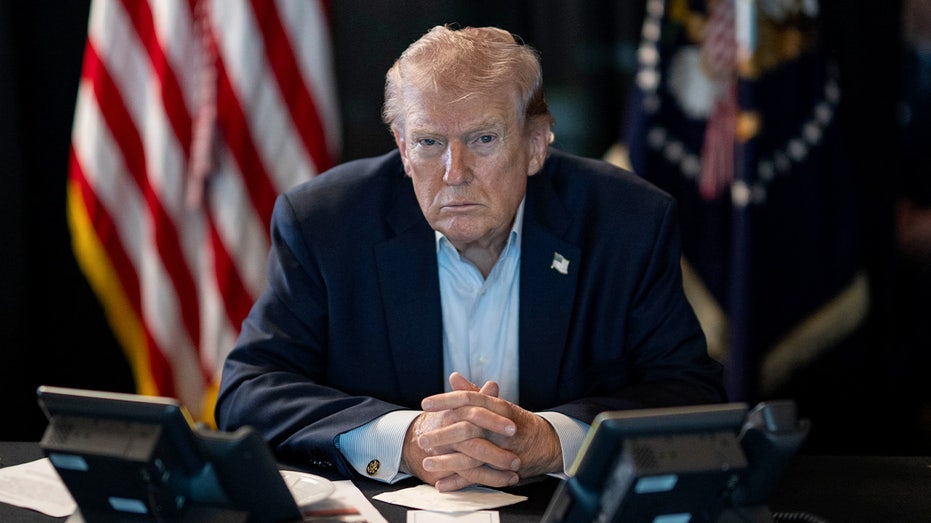





















There is tension in the Constitution as to which branch of government wields "war powers."
Article I, Section 8 of the Constitution gives Congress the power "To declare War," (right between the parts where Congress may "punish Piracies" and "grant Letters of Marque and Reprisal). But Article II, Section 2 says the president is "Commander in Chief."
The founders wanted to make power diffuse. That’s why certain constitutional authorities are spread out in the Constitution.
JONATHAN TURLEY: TRUMP STRIKES IRAN — PRECEDENT AND HISTORY ARE ON HIS SIDE
Congress has only declared war 11 times, the last being against Romania in the 1940s. But Congress has regularly approved resolutions authorizing the use of the military in overseas hostilities. That ranges from the Gulf of Tonkin Resolution, which got the U.S. into Vietnam. Contemporary resolutions are called "Authorizations for Use of Military Force" or AUMFs. Congress has approved those for the first Gulf War, after 9/11 and for the second Gulf War.
Congress wanted to reclaim some of its constitutional authority during Vietnam. So it adopted the War Powers Act in 1973. Multiple administrations from both parties have never formally recognized the War Powers Act as constitutional. But various presidents have sent notifications to Congress to comport with the War Powers Act. That includes notifying Congress within two days of sending troops abroad and having a 60- to 90-day window to draw down forces.
The Senate likely votes Wednesday night on a war powers resolution. If it passes — and if the House were to approve a companion version — technically, the U.S. must stop the war.
A simple majority is needed in both bodies. And while there may be some defections on both sides, we don’t believe the House and Senate will vote to terminate the war.
Regardless, Trump could veto an approved war powers resolution for Iran.
WHY TRUMP INVOKED REGIME CHANGE IN ATTACKING IRAN, AND THE MEDIA MUST LEARN FROM PAST MISTAKES
It’s about the math.
It takes a two-thirds vote to overcome the veto. So, even if Congress voted to halt the war in Iran, lawmakers can do little to overcome a veto.
Perhaps the only other parliamentary remedy lawmakers have is the power of the purse. Congress could always vote to cut off money for a particular operation. The Democratic-controlled Congress did that nearly 20 years ago after the second war in Iraq. But lawmakers realized they just couldn’t end operations right away. They needed a lengthy drawdown to prevent leaving American forces in the lurch.
Congress approved the Pentagon’s spending plan just a few weeks ago. Had that not happened, one could imagine a possible military government shutdown as Democrats would balk at sending money to the Pentagon unless there were provisions to suspend money for Iran.
MIKE DAVIS: WHY TRUMP'S IRAN STRIKE WAS NECESSARY AND LAWFUL
And what is past is prologue.
It’s highly likely that this intensifies the conversation about money for the Pentagon as we approach the next spending deadline in the fall. Democrats will look to put strings on any money bound for Iran operations — to say nothing of Venezuela.
Moreover, the U.S. seems to be fine with munitions and arms now. But the U.S. will eventually need to reload.
Senate Armed Services Committee Chairman Roger Wicker, R-Miss., did not rule out the potential need for a "supplemental" spending bill for Iran down the road.
In other words, there are 12 annual spending bills. This would be a "13th" spending bill and is specific to Iran.
Congress passed a number of those supplemental spending bills after 9/11. That’s one of the reasons the deficit started to skyrocket over the past two decades.
The post The Hitchhiker's Guide to Congress' options on hamstringing Trump's war powers in Iran appeared first on FOX News