









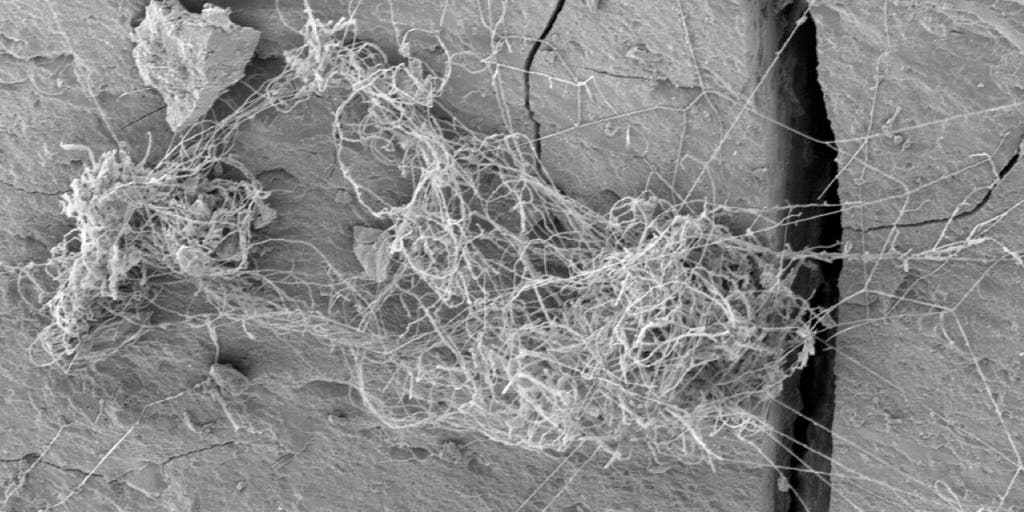





















Hidden deep beneath the Great Lakes, scientists have discovered a world of fungi, worms and tardigrades, revealing that life can thrive in places where researchers once believed it would be impossible.
WILDLIFE OFFICIALS URGE RESIDENTS TO KILL INVASIVE ARGENTINE TEGUS SPREADING DISEASE
In a recent study published in The ISME Journal, researchers from the University of Michigan found that organic-rich rock deep underground supports diverse fungal communities.
"The discovery opens a window into a world that is dark, ancient and almost entirely hidden — but is far from lifeless," lead author and University of Michigan doctoral candidate Quinn Moon said.
The discovery was made hundreds of feet below the Great Lakes region, where water samples had been isolated from the surface world for thousands of years.
The research team identified 689 fungal species, including 13 newly described species, from underground water samples collected at 1,640 feet below Earth’s surface.
The findings mark the first time researchers have successfully quantified fungal abundance in a deep subsurface environment at this scale.
"Our study challenges the idea that it’s inhospitable for more complex life like fungi in the deep subsurface, and under favorable conditions, eukaryotes can actually be quite abundant," Moon said.
The scientists collected water samples from gas wells sites and studied Antrim Shale, a rock formation beneath the Great Lakes region.
They then used genetic sequencing, microscopy and laboratory techniques, to study the organisms that were living in this dark, isolated ecosystem.
HOW WEATHER TURNED THE GREAT LAKES INTO A SHIPWRECK GRAVEYARD
The team also discovered other complex organisms, including tiny segmented worms and tardigrades, also known as water bears. Together, researchers say these organisms may form an underground food web, where some species consume others while others may survive as parasites.
Researchers found that a single drop of this underground water could contain as many fungal cells as a drop of ocean water. That equals roughly 250 fungal cells in one drop or more than 12 trillion fungal cells in an Olympic-sized swimming pool.
"We propose in the paper that we may be meaningfully underestimating the biomass and diversity of fungi on the planet because we’ve never incorporated the subsurface into estimates of global fungal biodiversity," Moon said.
GREAT LAKES SHIPWRECK DISCOVERED 132 YEARS LATER REVEALS TRAGIC STORY
Researchers say this study shows how fungi may play an important role in the deep-hidden underground ecosystems by helping break down organic material and influencing how carbon is stored and moved through Earth.
RARE, ALMOST EXTINCT WILD HORSE BORN AT THE BRONX ZOO
Scientists say the findings suggest the deep subsurface may contain far more biodiversity than previously estimated.
They now think a significant portion of fungal life may have been hiding beneath our feet all along.
The post See it: Hidden fungal world discovered more than 1,600 feet beneath the Great Lakes appeared first on Fox Weather