
































BREVARD COUNTY, Fla. – Launch time is almost upon us as NASA officials begin the final preparations for the launch of Artemis II.
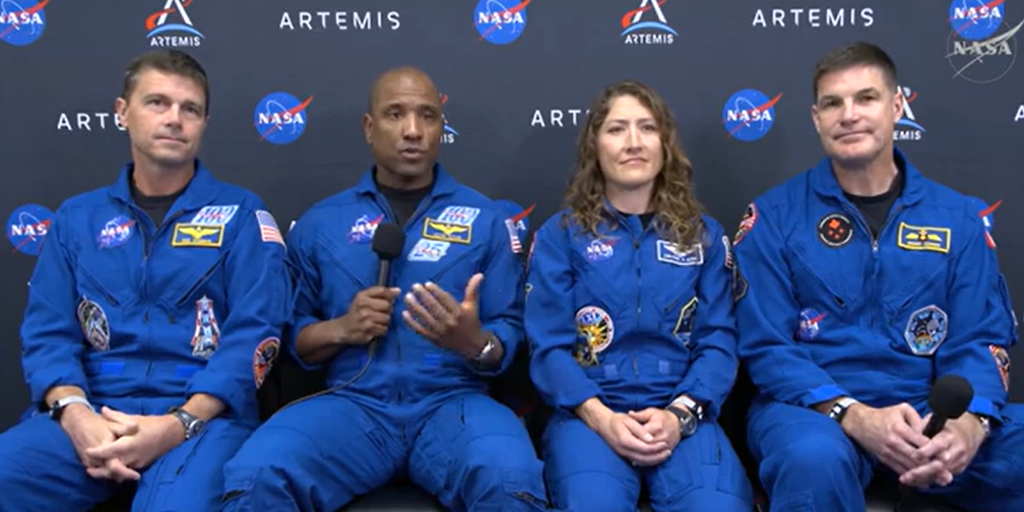
NASA officials, along with the Artemis II astronauts, took the stage Sunday to answer questions about how the mission's final stages are going and any last-minute details that need to be addressed.
A popular question for Commander Reid Wiseman entailed what to expect in terms of manual control of the ship, the Orion.
NASA ANNOUNCES ARTEMIS II MISSION PHASES, PLANS FOR FUTURE ARTEMIS PROGRAM LAUNCHES
Team member and pilot Victor Glover said manually flying these ships is an important evolution needed for the next two missions to have this capability.
"We are essentially going to make sure that vehicle flies the way that we think it does, that we designed it to do," Glover said. "And so, we're going to not only fly the vehicle manually, we're gonna execute the six degrees of freedom, so translating forward, backwards, left, right, up and down, and then also being able to rotate, pitch, on roll and pitch on roll."
Both Wiseman and Glover will be in the first two main seats for the launch of the Orion.
Wiseman reflected on his role as commander of the crew and how they would address certain issues, noting that no quick split-second decisions would ever be made alone, and stating that there are "no fast hands" in the cockpit.
An additional area of concern to monitor leading up to the launch is the weather. Exploration Ground Systems Manager Shawn Quinn stated that they will be watching for cumulus clouds, the thick cloud rule and strong winds.
According to NASA, sustained winds exceeding 37.5 knots or peak winds exceeding 52.8 knots warrant delaying the launch for safety reasons.
Despite this, Quinn states that based on the current weather, the mission is forecast to be 80% a go for Wednesday afternoon.
NASA is working closely with the National Oceanic and Atmospheric Administration (NOAA) to predict what kind of space weather will be ongoing at the time of launch.
According to Quinn, all final tests for the mission, including radio-frequency tests with the launch vehicle and spacecraft, have passed as we rapidly approach the official launch countdown.
NASA'S ARTEMIS MISSIONS: EVERYTHING YOU NEED TO KNOW AHEAD OF THE HISTORIC MOON LAUNCH
Part of this large operation includes the hard-working and dedicated Mission Evaluation Room Team, experts who support the Flight Control Team. They are comprised of experts from across NASA, including U.S. and European teams, to tackle any issues that may arise.
Program Manager Howard Hu addressed any doubts about the technology's capabilities and the crews' abilities, as this would be the first flight with a complete life support system.
"Uniquely for life support, we put humans with the life support system, both in the cabin environment and also in the spacesuits," Hu said. "And we've been designing the system since the very beginning of the program, and over the last decade plus, we've done testing across the board with suits."
In the event that things do not go as planned, the Orion ship has a unique capability to backtrack on the crew's journey. In this case, it would be an abort scenario initiated by the team.
NASA PAUSES GATEWAY LUNAR-ORBIT SPACE STATION TO BUILD LUNAR BASE ON THE MOON
There are three types of "abort" scenarios that could occur. One is called an LAS abort, a launch abort system, where the spacecraft would land relatively close to the launch site. The second, an untargeted Atlantic abort, would land somewhere across the Atlantic near Africa. The third abort scenario would be ideal, with the possibility of a single orbit, then returning to a near-nominal landing site in San Diego.
Hu reinforced the idea that it would be more of an early return than an "abort," but noted the ship's capability to return to Earth at any point along the mission's trajectory.
Officials are confident that after continuous testing, the flight software that controls life support and other essential functions will perform as expected.
So most of the public's understandable concerns have been sincerely dismissed as officials believe the mission is truly ready to go.
Regarding returning and docking the ship, Wu stated that the Orion ship and the Artemis II mission give the crew the opportunity to "test drive the car." This is a utility that will be studied for the next Artemis mission: whether crew members will have to physically dock the ship or if it would be an autonomous capability so no one needs to take over.
This is something that is going to be very important as more control is given to pilots, but will ultimately be decided later down the line.
MEET THE ASTRONAUTS PREPARING FOR HUMANITY’S RETURN TO THE MOON ON THE ARTEMIS II MISSION
Wu went on to share that the Artemis II team will get as close as 252,799 statute miles away from the moon. This will be 4,144 miles closer than the Apollo mission has ever gone.
This mission is the proper stepping stone for the overall plan to build a base on the moon and to establish an enduring American presence in space, as the forefront of expanding human exploration across the universe.
The post Final preparations underway for the launch of NASA's Artemis II space mission appeared first on Fox Weather