











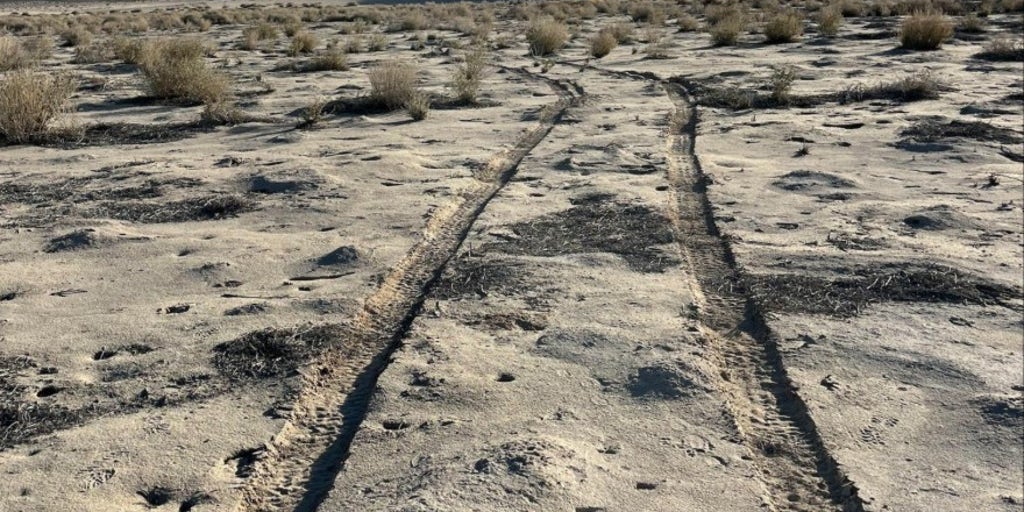



EUREKA VALLEY, Calif.– The hottest, driest and lowest national park in the U.S. is asking for help identifying a vehicle that illegally drove through Eureka Dunes, damaging miles of rare plants that exist only in Death Valley.
Eureka Dunes are the tallest dunes in California, according to the National Park Service. They stand 680 feet above the lake bed at their western base.
THIS ROCK IN ARCHES NATIONAL PARK WILL FALL, IT'S ONLY A MATTER OF TIME
On Tuesday, Death Valley National Park put out a call for help to the public, sharing photos from the aftermath of an incident on Dec. 17, 2025, where someone illegally drove through Eureka Dunes.
The national park said the illegal driving left five miles of vehicle tracks and damaged rare, sensitive desert plants, including species that exist nowhere else on Earth.
Eureka Dunes are only open for foot traffic, not vehicle traffic.
WATCH: HAWAII'S KĪLAUEA VOLCANO ERUPTS, SENDING RAGING LAVA FOUNTAIN 1,500 FEET INTO THE AIR
"Eureka Dunes are a special place meant to be enjoyed on foot," Death Valley National Park Superintendent Mike Reynolds said. "They are protected as wilderness. Please help us identify those responsible for damaging these fragile resources."
Though Eureka Dunes might appear to be a miles-long expanse of only sand, the dunes actually contain three special plants which have their entire range limited to the dunes, the national park said.
SEE IT: RARE BUS-SIZED PHANTOM JELLYFISH CAUGHT ON DEEP SEA VIDEO OFF ARGENTINA'S COAST
On the higher slopes of the sand dunes, you can find Eureka Dunegrass, a federally listed threatened species that has a dense root system and stiff, spiny leaftips that protect the plant from being disturbed by hikers or herbivores.
The Shining Milkvetch is another species that is limited to Eureka Dunes.
A candidate for the endangered species list, the Shining Milkvetch is a hummock-forming plant like the dune grass. Nodules on the plant's roots gather nitrogen from the air, an important nutrient not available in the sand, and the plant reflects excess light and heat with a covering of silvery hairs to conserve moisture.
The dunes also feature a plant called the Eureka Dunes Evening-primrose, a large, white flower that blooms at night to take advantage of pollinators that avoid the heat of the day, Death Valley National Park said.
Death Valley National Park said anyone with information on the vehicle that drove through the dunes can report it by calling, emailing or submitting a tip at the National Park Service's Investigative Services page.
The post National Park Service needs your help after miles of rare plants were damaged in the hottest place on earth appeared first on Fox Weather