



































- Oil isn't the only commodity market being thrown into disarray by the Iran war.
- Don't overlook the impact pricier sulfur or fertilizer might have on your wallet.
- The AI trade is also exposed due to its reliance on helium.
Up to this point in the Iran war, oil has hogged all the market headlines. How could it not?
It spiked almost 40% in just over a week. Then it continued higher above $100 per barrel … then broke $110. On two occasions, it briefly tested $120. The whole thing has been a roller-coaster ride.
But while oil has been the headliner, smaller commodity markets have been seeing their own disruptions — the kind that snarl global supply chains and ultimately impact everyday consumers.
As always, the critical chokepoint is the Strait of Hormuz. Here are three key commodity markets facing bottlenecks as long as the key passage stays closed:
Sulfur
A byproduct of oil and gas processing, sulfur is a key ingredient in sulfuric acid, which is used to extract metals like copper and lithium. These materials are in high demand amid the rapid build-out of AI data centers, and for the production of EVs. Any prolonged disruption risks making both more expensive.
Another use for sulfur? Making …
Fertilizer
As the chart below shows, the price of fertilizer has skyrocketed since the start of the Iran war. That's because one-third of global trade flows through … you guessed it … the Strait of Hormuz.
The way everyday people will feel that is through the price of food. Inflation is already a hot-button topic, and the prospect of paying more at the gas pump and at the supermarket could eventually spur a consumer-spending downturn.
<script type="text/javascript" defer="" src="https://datawrapper.dwcdn.net/ssGbC/embed.js" charset="utf-8" data-target="#datawrapper-vis-ssGbC"></script><noscript>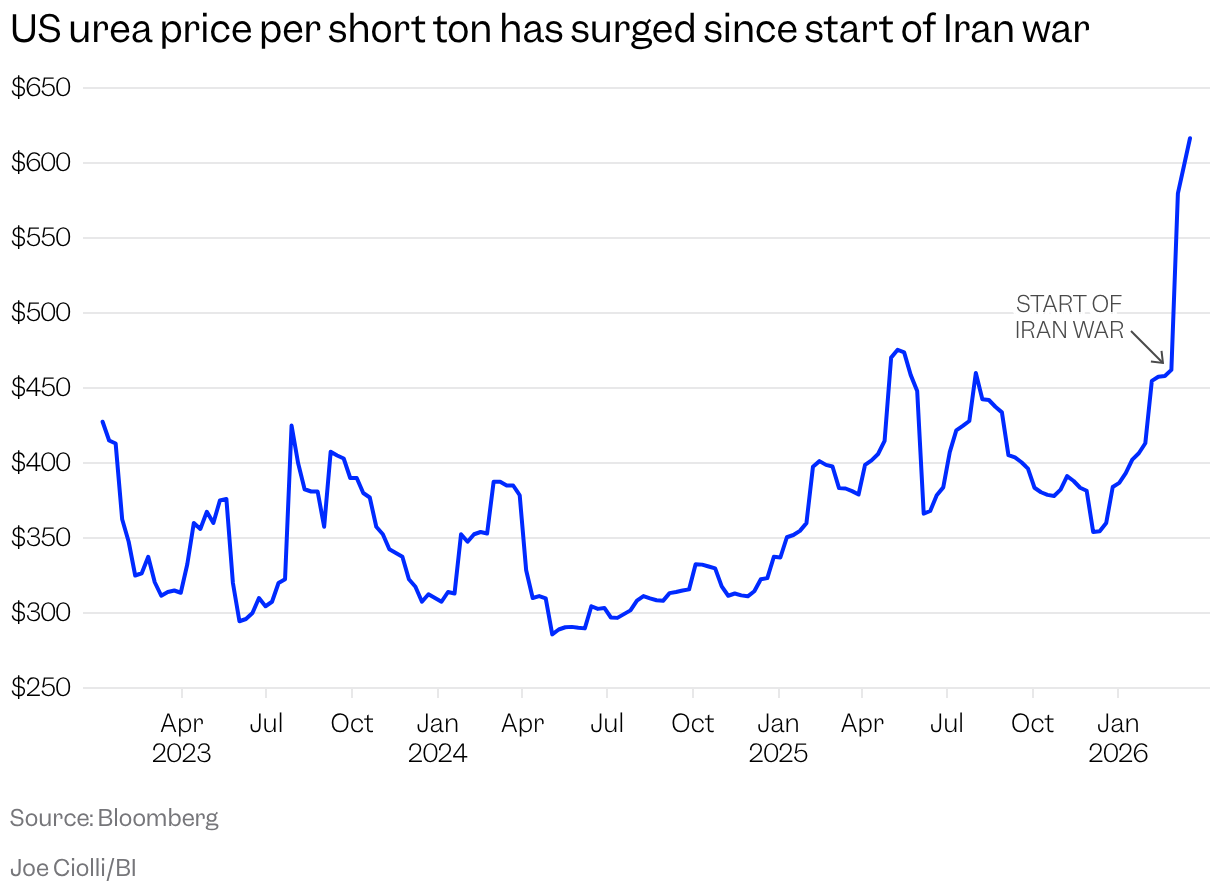 </noscript>
Helium
That collective gasp you just heard was birthday-party entertainers everywhere realizing they could be paying a lot more for balloon gas. But perhaps more critically to the global economy, helium is also a key component in semiconductor manufacturing.
That's right, the Iran war could (indirectly) come for the AI trade. Any prolonged increase in helium prices could make chips more expensive.
Helium is also necessary in other non-AI capacities, like cooling MRI machines and pressurizing fuel tanks during rocket launches.
And this is just a selection. There are many more disruptions to explore. First Trade will do its best to keep you informed — hopefully before you start to feel any of them.
The post 3 commodity disruptions beyond oil that could soon hit your wallet appeared first on Business Insider