




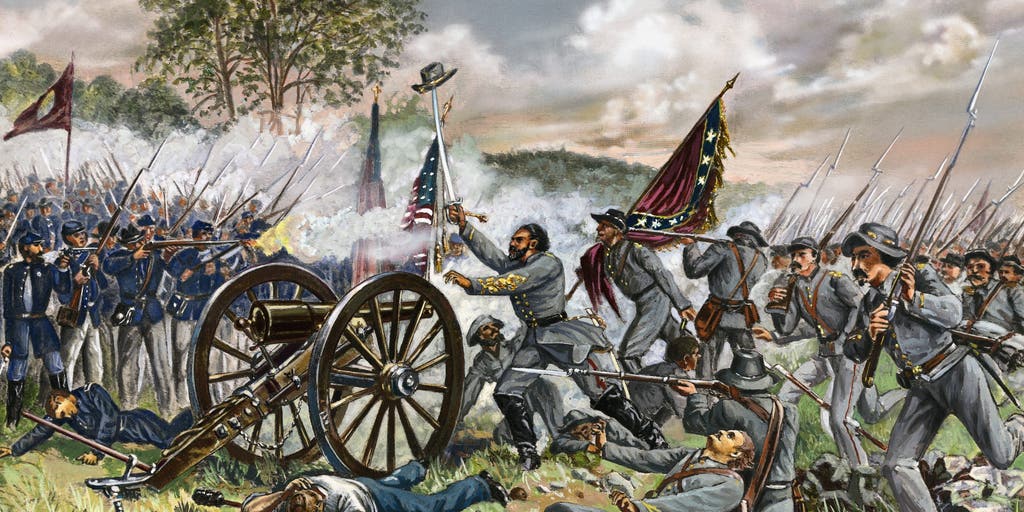





















The Battle of Gettysburg, which occurred from July 1 to July 3, 1863, is considered one of the most significant moments of the American Civil War. What were the weather conditions like, and how did they affect soldiers?
As the 250th birthday of our great nation approaches, soldiers have always endured dangerous conditions when battling the enemy, but many do not realize how the weather affected one of the greatest battles of our country’s young history.
This battle was a major turning point in the war, in which the Confederate Army clashed with Union troops at the crossroads of Gettysburg, Pennsylvania.
By the second day of fighting, a total of 150,000 soldiers had converged on the Gettysburg area, according to the National Guard, who notably contributed at the start of the battle as a state militia, early forerunners of the force we have today.
In the end, the battle claimed the lives of over 51,000 soldiers from both sides.
Due to nearly 70,000 Confederate troops converging from all angles on Union defenses, soldiers were faced with the threat of gunfire while also enduring unbearable hot weather.
During the Civil War, a soldier could expect to march an average of 15 miles a day.
ANCIENT DISCOVERY: LOST PAGES OF THE NEW TESTAMENT REVEAL LETTERS OF THE APOSTLE ST. PAUL
According to the National Museum of Civil War Medicine, there were over 7,000 cases of sunstroke recorded during the four years of war, with over 300 resulting in death.
During the Battle of Gettysburg, Reverend Doctor Michael Jacobs, a local math professor, had a keen interest in the weather and would often record his observations three times each day.
Reverend Jacobs noted that the first three days of the battle were cloudy, with temperatures lingering in the high 70s.
THE WEATHER BEHIND D-DAY: HOW METEOROLOGISTS INFLUENCED OPERATION OVERLORD
By 2 p.m. on the first day of the battle, temperatures reached 76 degrees.
According to his notes, on the evening of July 3, a tame thunderstorm appeared, which eventually brought early-morning rain showers at 6 a.m. on the last day of battle.
FROM SECRET SCIENCE TO PUBLIC HISTORY: MANHATTAN PROJECT PARK MARKS 10 YEARS
The warmest day of battle occurred on July 3, when temperatures reached 87 degrees by 2 p.m.
Union uniforms were typically made of 100% wool and were very hot in the South during the summer.
Wool was chosen over cotton or linen due to its durability and ability to shed water, which is good for the winter months, but deadly during summer marches.
The Confederate uniforms were also a mix of wool and cotton.
EVERYDAY INNOVATIONS BORN FROM SPACE TRAVEL
Union uniforms were typically in better shape than Confederate ones, but both sides had their fair share of clotheless and shoeless soldiers.
On top of the warm uniform, soldiers carried equipment such as a haversack, drinking water, a cartridge box, a firearm and other items.
Even if a soldier did have water in a canteen, it was often warm and full of bacteria.
SUNKEN WWI SHIP 'TAMPA' FOUND OFF ENGLISH COAST, SOLVING CENTURY-OLD MYSTERY
The National Museum of Civil War Medicine cites personal accounts of Civil War soldiers during the unimaginable struggle dealing with the summer heat, often using any source of water they could find.
"How many wiggletails and tadpoles I have drunk will never be known," Pvt. Marcus Toney said of the 1st Tennessee Infantry.
All of these factors make for an even deadlier outcome during one of the bloodiest battles of the Civil War.
At the time, British medical officers in India who dealt with year-round hot temperatures had come up with a solution to treat heat stroke by stripping a soldier down to his trousers and pouring a stream of water on the patient’s head, neck, chest and along the spine, according to the National Museum of Civil War Medicine.
Eventually, American surgeons adopted this practice, while some people stuck with older remedies.
If a soldier were lucky enough to be close to a hospital, doctors would wrap the patient in a wet sheet and fan "vigorously" until they returned to normal temperature.
JURASSIC GIANT: WORLD’S MOST COMPLETE T-REX FOSSIL COULD SELL FOR $30 MILLION AT AUCTION
Being a soldier in the Civil War entailed much more than dodging bullets and defending against muskets armed with bayonets; it also involved being weather-aware and adapting to the hot climate in any way possible.
The post Wool uniforms and extreme heat: A firsthand account of weather during the Battle of Gettysburg appeared first on Fox Weather