















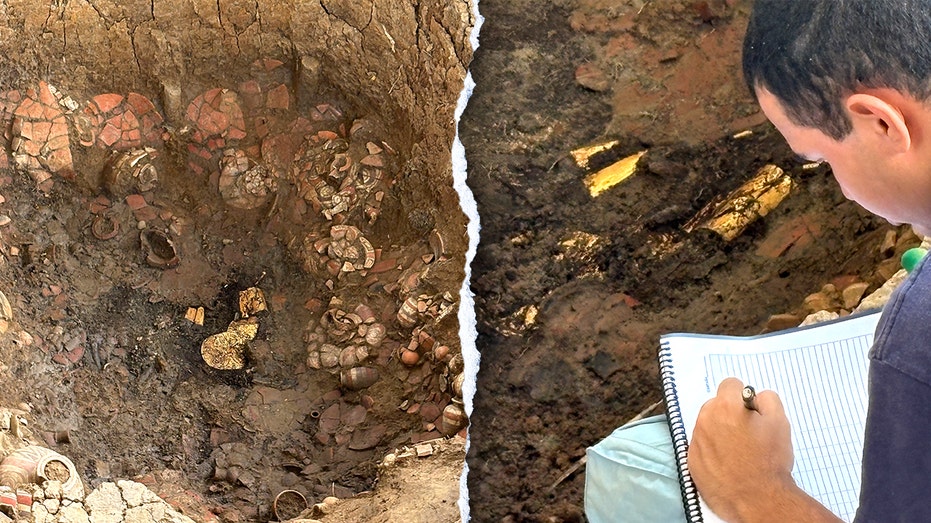





















Archaeologists recently unearthed a gold-laden burial in Panama — an epic discovery that dates back over 1,000 years.
The Ministry of Culture of Panama announced the discovery, made at the El Caño archaeological site in Panama's Coclé Province.
The tomb contained several gold and metal artifacts, including chest plates, ear ornaments and bracelets, as well as "finely crafted ceramics." The tomb is called Tomb 3.
POLICE STUMBLE UPON ANCIENT SHIPWRECK AMID ROUTINE PATROL, KEEP LOCATION SECRET TO DETER LOOTERS
Though archaeologists first identified Tomb 3 in 2009, they didn't realize the complexity of the structure — or the extent of its funerary offerings — until now.
The grave was centered around one individual "surrounded by a series of prestige objects demonstrating his high status within his community’s sociopolitical hierarchy," the ministry said in a translated Feb. 20 statement.
Ministry officials called the discovery a "highly significant event for Panamanian archaeology."
"El Caño has become one of the most important pre-Hispanic cemeteries in the region, associated with societies that inhabited central Panama between the 8th and 11th centuries A.D.," the statement said.
"The new tomb expands the known funerary record and will provide new information on social organization, political power, trade networks, and ritual practices, among other aspects."
TEST YOURSELF WITH OUR LATEST LIFESTYLE QUIZ
The gold objects indicate that the person was "high status," said Alexa Hancock, an anthropologist at Fundacion El Caño, the organization that oversaw the excavation.
Hancock told Fox News Digital six gold artifacts have been recovered so far: two breastplates, two arm cuffs and two ear-rods.
The stones in the ear rods have not yet been identified, Hancock said.
The designs on the objects indicate the decedent's family line.
"The gold was used because it was a material that would preserve the message or information of what lineage the people in the tomb belonged to," she noted.
CLICK HERE TO SIGN UP FOR OUR LIFESTYLE NEWSLETTER
"There is nothing found in this or any other tomb in El Caño so far that identifies any of the individuals buried in the tomb by name."
As for the origin of the gold objects, Hancock described them as "local Panamanian craftsmanship."
"The team at the El Caño Foundation conducted a year-long investigation in 2023 to confirm the origins of artifacts recovered from the [other] tombs [at the site]," she said.
"The artifacts specifically investigated were the gold, emeralds and pyrite mirrors. The gold was confirmed to be Panamanian in origin through elemental analysis and the designs were [from the] Gran Coclé time period."
CLICK HERE FOR MORE LIFESTYLE STORIES
The latest excavation of the tomb began in January.
It was set to conclude March 6.
Hancock added that work at the site won't be complete until the excavation season of 2027 wraps up.
"At this point, it is unconfirmed even how many individuals are buried in the tomb," she said.
"There are a minimum of three individuals identified — but there are probably more. This tomb is somewhat smaller in general size, more long than round."
The post Archaeologists uncover gold-laden tomb filled with elite burial treasures from over 1,000 years ago appeared first on FOX News