









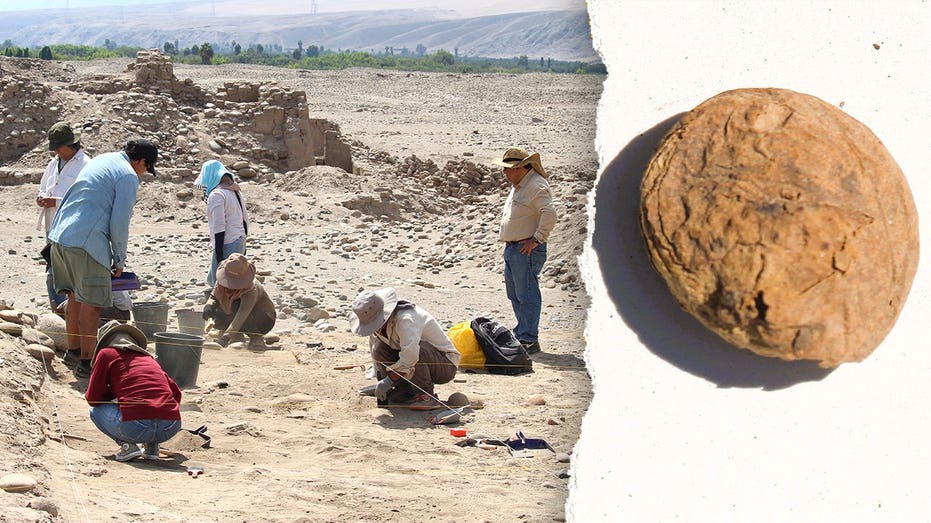





















Archaeologists in Peru recently uncovered an unusual find: freeze-dried potatoes that date back centuries before the United States was even founded.
The potatoes, known as chuño, were found at the Tambo Viejo site in the Acarí Valley in southwestern Peru. The discovery was recently published in the Journal of Field Archaeology.
The potatoes date back roughly 500 years, to the time of the Inca Empire, according to Phys.org.
RESEARCHERS DISCOVER 2,500-YEAR-OLD HONEY RESIDUE IN ANCIENT BRONZE JARS
Photos of the ancient food show two wrinkled, brownish, freeze-dried potatoes that still appear to retain their shape and color, looking strikingly like modern-day produce.
The preservation of the potatoes is "excellent," said Lidio Valdez, an archaeology professor at the University of Calgary, who led the excavation.
Valdez told Fox News Digital that the two freeze-dried potatoes are remarkably similar.
"The only difference is the samples found are small, and it seems that over time and due to the aridity of the region, their original size was reduced," he said. "There is no way one can tell their old age from samples."
ARCHAEOLOGISTS UNEARTH ANCIENT BREAD THAT SURVIVED UNDERGROUND FOR 5,000 YEARS
The significance of the discovery, Valdez said, is that it shows the Inca transported food over long distances.
"Freeze-dried potatoes can be produced only at high elevations," he said. "Afterward, the chuño were stored in state-controlled warehouses, most of them built also at high elevations."
"Because the Inca state carried out countless projects throughout the realm, the tasks involved thousands of workers, who had to be fed by the state. Thus, state officials likely mobilized volumes of chuño from the warehouses, transporting them in llama caravans."
At Tambo Viejo, the potatoes were then placed in ceramic vessels and stored underground to avoid food waste.
CLICK HERE TO SIGN UP FOR OUR LIFESTYLE NEWSLETTER
Potatoes have high water content, Valdez added, which means they don't survive long "in most places," making Incan preservation methods particularly impressive.
"Place a potato somewhere in your kitchen just for a month and see what will happen," he said. "In places with rain and moisture, potatoes will rot quickly. Therefore, freeze-drying was [and] is an effective way to preserve and store them for long periods of time."
While freeze-dried potatoes may seem like a specialty ingredient, Valdez said the Inca considered chuño a staple food.
"Those who built the empire … palaces, roads and everything else we admire, [like] Machu Picchu … lived off the chuño," he said. "It appears that in Inca times, large volumes of potatoes were cultivated and freeze-dried, then stored in state-controlled warehouses."
CLICK HERE FOR MORE LIFESTYLE STORIES
The archaeologist said he had hoped to learn more about the Inca recording system, known as khipus, because Tambo Viejo was an administrative center. Instead, he was surprised to uncover evidence of ancient food preservation.
Valdez described Tambo Viejo as "such a great Inca site," noting that it's been excavated on and off since 2018.
"Many wonderful finds have been discovered at the site," he said. "Almost everything found at the site is unprecedented, which makes Tambo Viejo such a unique center."
The find adds to a growing number of archaeological discoveries that have shed light on the foods eaten — and preserved — by ancient civilizations.
Last year, archaeologists in Italy uncovered preserved food remains in ancient Pompeii, including fruit and fava beans.
TEST YOURSELF WITH OUR LATEST LIFESTYLE QUIZ
In April, Swiss officials announced the discovery of a charred 2,000-year-old Roman bread loaf unearthed during an excavation in Windisch, marking the first archaeological find of its kind in the country.
The post Archaeologists uncover freeze-dried potatoes older than the US in 'excellent' condition appeared first on FOX News