

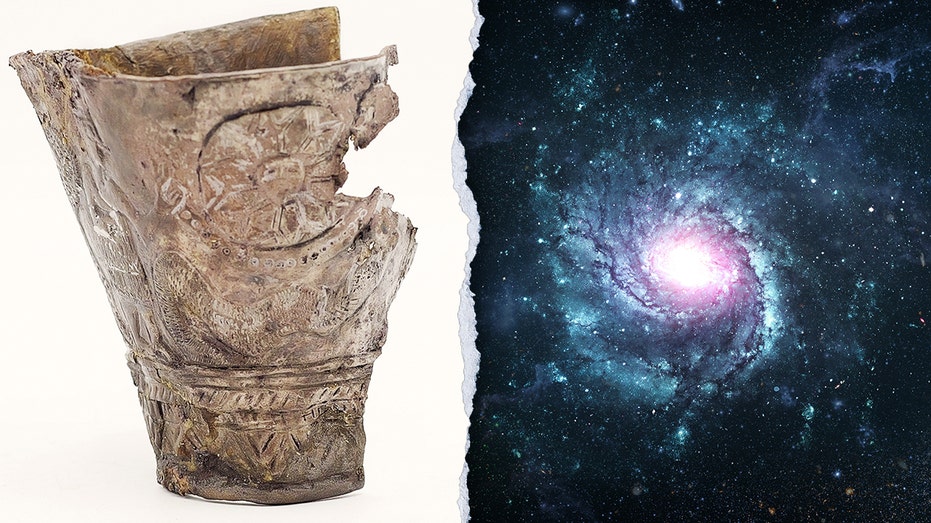
Researchers believe they've found the oldest-known depiction of cosmic creation — carved into a small silver cup unearthed over half a century ago.
The ˁAin Samiya goblet, discovered in the West Bank in 1970, is the subject of new research about how ancient people viewed the universe — and primordial chaos — in antiquity.
The cup was found in a sealed shaft tomb near the Palestinian town of Kafr Malik in the West Bank. It dates back to the Intermediate Bronze Age, roughly between 2650 and 1950 B.C.
ANCIENT CHRISTIAN FIGURINES DISCOVERED IN 1,500-YEAR-OLD DESERT GRAVES
The cup depicts the moment of cosmic creation, when the universe was created and the cosmos formed, according to a study published in November in the Journal of the Ancient Near Eastern Society.
Study author Eberhard Zangger, a geoarcheologist and the president of the Switzerland-based organization Luwian Studies, told Fox News Digital the cup presents "two remarkably precise scenes."
"On the left, we see a bull-man: a single human upper body with two faces, joined to two bull hindquarters — four hind legs in total," he said. "On the right, two human figures once stood, although only one is fully preserved today."
Zangger added, "Together, they hold a semicircular arch in which a radiant, human-like face appears. In both scenes, a serpent is present — dominant in the left panel, subdued in the right."
Zangger said he considers the depiction exceptionally unique, as no similar depiction has been found before.
CLICK HERE TO SIGN UP FOR OUR LIFESTYLE NEWSLETTER
"What makes the goblet extraordinary is that it offers, for the first time, a graphic representation of how people imagined primordial chaos, the state that existed before creation," he said.
"In the Hebrew Bible, this state is called tohu wa-bohu. Echoes of it appear as late as Greek philosophy. … The cup visualizes this earlier, undifferentiated state from which the ordered world later emerged."
He said the artist likely belonged to the Third Dynasty of Ur in southern Mesopotamia, now southern Iraq.
"It provides insight across a vast geographical area and over at least two millennia, likely far more. Creation myths certainly evolved and differed from region to region, but fundamental ideas recur with striking consistency."
CLICK HERE FOR MORE LIFESTYLE STORIES
Previously, scholars believed the cup depicted a mythological combat scene — something that Zangger disputes based on his interpretation.
"We interpret the arch held by the two figures on the right as a celestial boat," he said, citing similar art from Mesopotamia, Egypt and Anatolia.
"The symbolism highlights the stability, order and cyclical nature of the cosmos: the rebirth of the sun each morning, the renewal of vegetation in spring and the dependable rhythms that make human life possible," he said.
"Maintaining this cosmic order was seen as a shared responsibility between gods and humans. Before cosmic order emerged, chaos prevailed — symbolized by the serpent. Chaos never disappears; it remains present but subdued as long as order is upheld."
TEST YOURSELF WITH OUR LATEST LIFESTYLE QUIZ
A key point, Zangger added, is that artifacts "should not be viewed in isolation."
He stressed the importance of comparative archaeology — considering finds from other regions and time periods.
"When we do that, we see how early ideas about creation developed — many of which still resonate in modern cultures," he said, citing the star and crescent on Turkey's national flag as a modern echo of ancient celestial symbols.
"The long continuity of these symbols underscores how deeply ancient cosmological concepts remain woven into our cultural identities," Zangger concluded.
The post Ancient silver cup may show world's oldest cosmic creation scene, researcher says: 'Chaos prevailed' appeared first on FOX News