

















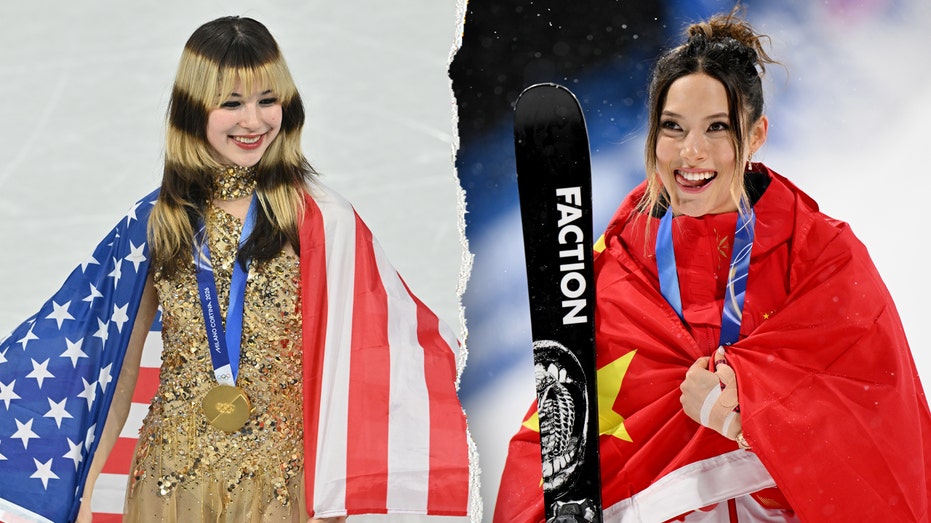





















Just minutes after Alysa Liu won a historic Olympic figure skating gold for the U.S., her story as the child of a Chinese American immigrant who fled communism spread like wildfire across social media.
Almost immediately, that discourse evolved, in many circles, into comparisons to another Chinese American superstar who has dominated headlines in Milan Cortina — American-born Team China skier Eileen Gu.
"Alysa Liu > Eileen Gu," Barstool Sports founder Dave Portnoy wrote in a post on X. "The triumph of America over China!"
CLICK HERE FOR MORE SPORTS COVERAGE ON FOXNEWS.COM
Other pundits were quick to point out the contrast between Liu's story, a tale of American loyalty among an immigrant's child, and Gu, who chose to compete for Team China when she was 15 years old despite living her life in California.
"Eileen Gu is unlucky that Alysa Liu’s patriotism stands in stark contrast to Gu’s betrayal of her country," American lawyer and political analyst Gordon Chang told Fox News Digital.
Just how different and how similar are the two Olympic superstars?
Liu's father, Arthur Liu, was there in Tiananmen Square in the spring and summer of 1989.
The Tiananmen Square protests, also known as the Tiananmen Square Massacre, proved to be a life-changing moment for Arthur and a history-changing moment for everyone else. Hundreds of Chinese students and residents in the capital city of Beijing were killed by the country's military for protesting the communist government.
Arthur was later summoned to report to the Office of Chinese Communist Party Youth League to address his presence that day.
"I refused to provide them any more names of students who had participated in the organization of the demonstrations. … I was going to take full responsibility for everything that had happened since at one time I was elected the president of the Guangzhou Autonomous Student Union of Universities," Arthur Liu told USA Today.
"Going to prison for me was a matter of time."
He had to sneak onto a boat to Hong Kong, risking up to three years in prison or a labor camp. The boat took an extended detour to avoid military detection. He later fled to California from there.
"His persistence, and he's brave too," Alysa told Fox News Digital of her father during a roundtable interview at the USOPC media summit in October. "We all knew about it. He had some stories for us, but we also found out from our other relatives. They would tell us as well."
In the 1980s, Gu's mother, Yan Gu, was a student at Peking University studying chemistry and biochemistry, according to The New York Times. She came to the United States to earn a master’s degree, eventually earning it from Stanford.
At age 40, Yan gave birth to Eileen, and raised her as a single parent, according to Olympics.com. Not much is known about Gu's father. Eileen has not publicly commented on him and declined to answer questions about him with The New York Times.
And Liu doesn't even know her own mother. She and Arthur's four other children were conceived using an anonymous egg donor and a gestational surrogate.
As a lawyer, Arthur Liu raised Alysa and her siblings in Oakland. Yan raised Eileen Gu across the bay in San Francisco.
Alysa began skating at age 5 when her father brought her to the Oakland Ice Center. She later trained under Laura Lipetsky, a former figure skater who had trained under figure skating Hall of Fame coach Frank Carroll.
Gu excelled as a student and as an athlete throughout her adolescence. She scored 1580 out of 1600 on her SAT exams. Every summer, she went back to China for a few weeks to get extra math practice, according to The Guardian.
Gu competed in her first Freestyle Ski World Cup in January 2019. At that time, she was representing the U.S.
But it was the last time Gu would represent the U.S.
It was called the Chinese naturalization project.
The project accelerated around 2018–2022, aimed at recruiting foreign-born athletes, primarily with Chinese heritage, to boost competitiveness, notably for the 2022 Beijing Winter Olympics and soccer, according to The China Project.
Gu and Liu were top recruiting targets.
Gu traded in her red, white and blue for red and gold. Just months after competing in her first Freestyle Ski World Cup for the U.S. in January 2019, she competed for China for the first time in June of that year after requesting a change of nation with the International Ski Federation.
In an announcement on Instagram, she said she made the decision "to help inspire millions of young people" in China and "to unite people, promote common understanding, create communication, and forge friendships between nations."
Seven years after the decision, Gu is the highest-paid Winter Olympic athlete in the world, making an estimated $23 million in 2025 alone due to partnerships with Chinese companies, including the Bank of China and western companies.
The Wall Street Journal reported last week that Gu and Zhu Yi, a fellow American-born figure skater who now competes for China, were paid a combined $6.6 million by the Beijing Municipal Sports Bureau in 2025 for "striving for excellent results in qualifying for the 2026 Milan Winter Olympics."
Overall, the two were reportedly paid nearly $14 million over the past three years.
The Lius remained loyal to Team USA.
Arthur was reportedly "not open to persuasion" to having Alysa compete for China, according to The Economist.
Both athletes competed at the 2022 Beijing Winter Olympics, Gu representing China and Liu representing the U.S.
Gu won two gold medals and one silver in freeskiing and went home to California as a new global household name for her success.
Liu finished in sixth place in women's singles figure skating, then went into a temporary early retirement.
Gu has become a target for global criticism this Olympics for her decision to represent China while remaining silent on the country's alleged human rights abuses.
In an interview with Time Magazine, Gu was asked her thoughts on China's alleged persecution of Uyghurs and other Turkic Muslim minorities in Xinjiang.
"I haven’t done the research. I don’t think it’s my business. I’m not going to make big claims on my social media," Gu answered.
"I’m just more of a skeptic when it comes to data in general. … So it’s not like I can read an article and be like, ‘Oh, well, this must be the truth.’ I need to have a ton of evidence. I need to maybe go to the place, maybe talk to 10 primary source people who are in a location and have experienced life there.
"Then I need to go see images. I need to listen to recordings. I need to think about how history affects it. Then I need to read books on how politics affects it. This is a lifelong search. It’s irresponsible to ask me to be the mouthpiece for any agenda."
Liu and her family, on the other hand, found themselves in the crosshairs of China's government ahead of the 2022 Beijing Games amid her father's past and her own refusal to compete for China.
Before her appearance in the 2022 Beijing games, she and her father were the alleged targets of a spying operation by the Chinese government.
US OLYMPIC GOLD MEDALIST ALYSA LIU WAS ONCE TARGETED BY CHINESE SPIES
Liu called the experience "a little bit freaky and exciting."
"You know what I mean? It's so … unbelievable. You know what I mean like, that's crazy," Liu previously told Fox News Digital at a roundtable interview at the USOPC Media Summit in October.
"Like, imagine finding that out at such a young age, I mean, like In a weird way, I was like, 'Am I like in some prank show?' Like, is this world real. Like, I must be some movie character. But, I mean, it was like it made sense to me, you know, from like everything my dad did back in his activist days."
One of the five men charged with spying on Chinese dissidents living in the U.S., Matthew Ziburis, allegedly contacted Arthur in November 2021, impersonating a USOPC official and asking for his and Liu's passport numbers, The Associated Press reported at the time.
Ziburis allegedly traveled to California’s Bay Area, where the Liu family lived, to surveil them and try to coax private information from the family that he could then supply to the Chinese government.
Her father told The Associated Press at the time, "They are probably just trying to intimidate us, to ... in a way threaten us not to say anything, to cause trouble to them and say anything political or related to human rights violations in China. ... I had concerns about her safety. The U.S. government did a good job protecting her."
The U.S. Department of Justice and FBI came to Liu's aid.
She first spoke with the FBI agent who would protect her family at length at a Japanese restaurant.
"I went, like, to eat dinner with her a couple times. I mostly talk, because, like, I'm also, like, really interested in what she does, like guys like, that's so cool to me. Like, I don't know, just like meeting with an FBI agent like that's crazy work," she said.
"You know, and I mean, like, not many people can do that. So I, you know, I have so many questions and, like, I've met with. Like, a psychologist there, not for me like because, I was like, so curious about, like, what she does."
Liu added the FBI made her feel "safe" throughout the situation.
The spy operation didn't scare Liu off from competing in Beijing. But she had heightened security assurances from the U.S. State Department and USOPC, and at least two people escorted her at all times when she was there.
She went into retirement shortly after the Beijing Games ended.
"She became really unhappy," Arthur Liu told USA Today about why she retired. "She avoided the ice rink at all costs. She's traumatized. She was just traumatized. She was suffering from PTSD, and she wouldn't go near the ice rink."
But Liu made her return to the sport just two years later in 2024. By March 2025, she was already making history for Team USA, becoming the first American the World Figure Skating Championships in 19 years.
Her comeback included a storybook ending with Thursday's gold medal performance.
Liu hasn't ruled out adapting her life and experience in an international spying incident into a movie.
Still, she has some preferences if her story makes it onto the big screen.
"They gotta make me look like a super cool hero or something. And just, I can't just be the kid that got spied on and did nothing about it," she said. "But, honestly, I would just have the main focus be like my dad's story because, like, his story is so cool and, like, also just like everything that only happened because of what he did, so, like, I feel like we got to start with the roots."
With Liu earning gold on Thursday, Gu is now the last athlete between the two chasing a gold medal. Liu's win on Thursday has ensured Gu will ski with the backdrop of viral, and often unflattering, comparisons to Liu by American patriots on social media.
Chang told Fox News Digital that Gu "should count her lucky stars she was born an American. A generous America allowed her to compete for China at the Beijing Olympics four years ago and then let her back into the country. If the reverse were true, and she had been born in China, the Chinese regime would not have been so indulgent."
Gu will compete in the women's freestyle skiing halfpipe final on Sunday after only winning silver in her first two events. The event was postponed from after severe snow made the original scheduled time on Saturday unsafe.
Gu had to overcome a near-disastrous crash during her first run of the qualifying round on Thursday to get to this final, and last chance to win Gold in Milan Cortina.
It will be the climax of a games defined by immense global criticism for Gu.
She brought backlash upon herself early in the games when she responded to a question about President Donald Trump criticizing U.S. Olympian Hunter Hess for being critical of the state of America.
"I’m sorry that the headline that is eclipsing the Olympics has to be something so unrelated to the spirit of the Games. It really runs contrary to everything the Olympics should be," Gu told reporters Monday.
"The whole point of sport is to bring people together. … One of the very few common languages, that of the human body, that of the human spirit, the competitive spirit, the capacity to break not only records, but especially in our sport, literally the human limit. How wonderful is that?"
Gu also claimed she had been "caught in the crossfire" herself.
"As someone who has got caught in the crossfire before, I feel sorry for the athletes," Gu said. "I hope that they can ski to their very best."
Vice President JD Vance weighed in on the controversy surrounding Gu in an interview Tuesday on Fox News' "The Story with Martha MacCallum."
"I certainly think that someone who grew up in the United States of America who benefited from our education system, from the freedoms and liberties that makes this country a great place, I would hope they want to compete with the United States of America," Vance said.
When asked if she feels "like a bit of a punching bag for a certain strand of American politics at the moment," she said she does.
"I do," she said. "So many athletes compete for a different country. ... People only have a problem with me doing it because they kind of lump China into this monolithic entity, and they just hate China. So, it's not really about what they think it's about.
"And, also, because I win. Like, if I wasn't doing well, I think that they probably wouldn't care as much, and that's OK for me. People are entitled to their opinions."
Gu has claimed she was "physically assaulted" for the decision.
"The police were called. I’ve had death threats. I’ve had my dorm robbed," Gu told The Athletic.
"I’ve gone through some things as a 22-year-old that I really think no one should ever have to endure, ever."
Follow Fox News Digital’s sports coverage on X, and subscribe to the Fox News Sports Huddle newsletter.
The post Alysa Liu vs Eileen Gu: How two Chinese American stars wound up on opposite sides of an Olympic proxy war appeared first on FOX News